A STONE DISPLAY SOLUTION EXPERT !



Showroom Tile Display Rack: 7 Layouts That Turn Visitors Into Buyers
Table of Contents
Two tile stores can stock the same bestsellers and perform nothing alike. The difference is usually where the samples stand and in what order visitors meet them. That is the job of the showroom tile display rack: it decides what gets seen first, what gets touched, and what gets quoted. Walk the aisles at Cersaie, the international tile exhibition in Bologna, and you will see the pattern everywhere: racks arranged as a journey through the collection rather than as storage rows. The seven layouts below borrow that pattern for a floor plan of your own.
| Layout | Where | Job It Does |
|---|---|---|
| Hero wall | Entrance | Stops traffic, sets the story |
| Tilted compare pairs | Main aisle | Side-by-side decisions |
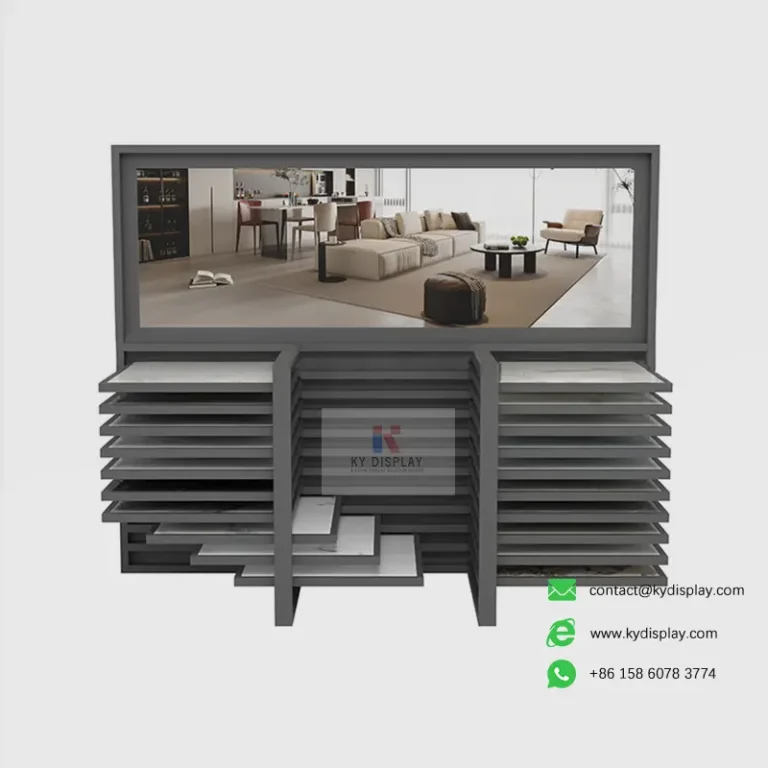
| Pull-out cabinets | Along walls | Deep range without clutter |
| Material zones | Floor quarters | Self-navigation by material |
| Sliding large-format zone | Dedicated bay | Big panels shown big |
| Touch counter | Every zone | Texture closes the sale |
| Light and signage | Overlay | Color truth and wayfinding |
Showroom tile display rack: Why the Fixture Decides the Sale
Tile is judged with the eyes and confirmed with the fingertips, so the rack is conversion equipment before it is furniture. The same logic runs through Coverings, the largest tile and stone show in North America: exhibitors put their strongest colors at eye level, group by material, and keep loose samples within reach. Visitors buy what they can see, touch and compare on their own. A floor planned around those three behaviors needs fewer staff answers and produces more confident quotes.
Layout 1: Start With a Hero Wall at the Entrance
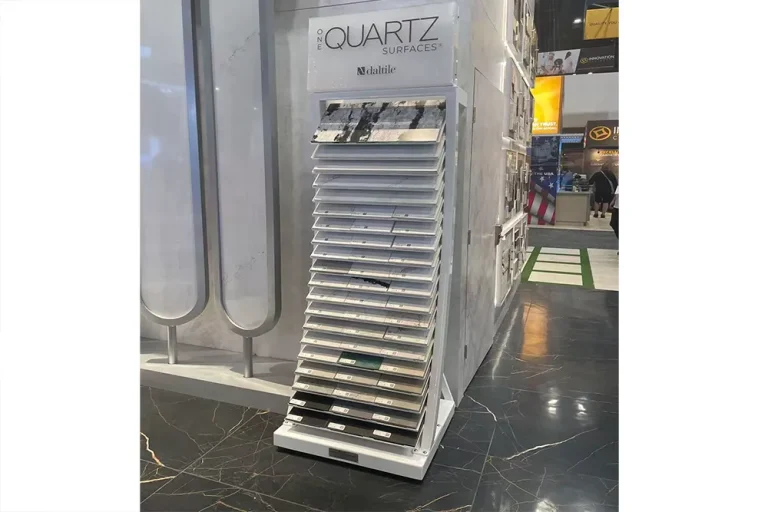
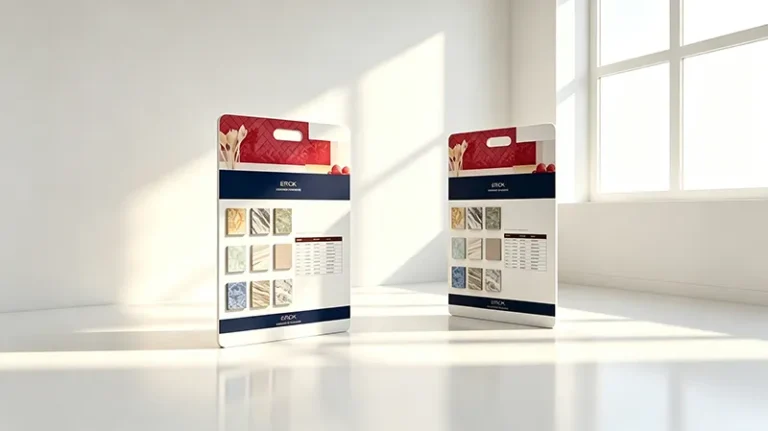
Give the first three meters of sightline to one statement: a full-height page-turning tile display rack loaded with your hero collection. The page-turning format matters here. Visitors flip large samples like a book, which invites handling in the first ten seconds and signals that everything on the floor can be touched. Change the hero wall with each season so repeat visitors always meet something new.
Layout 2: Pair Tilted Racks for Side-by-Side Comparison
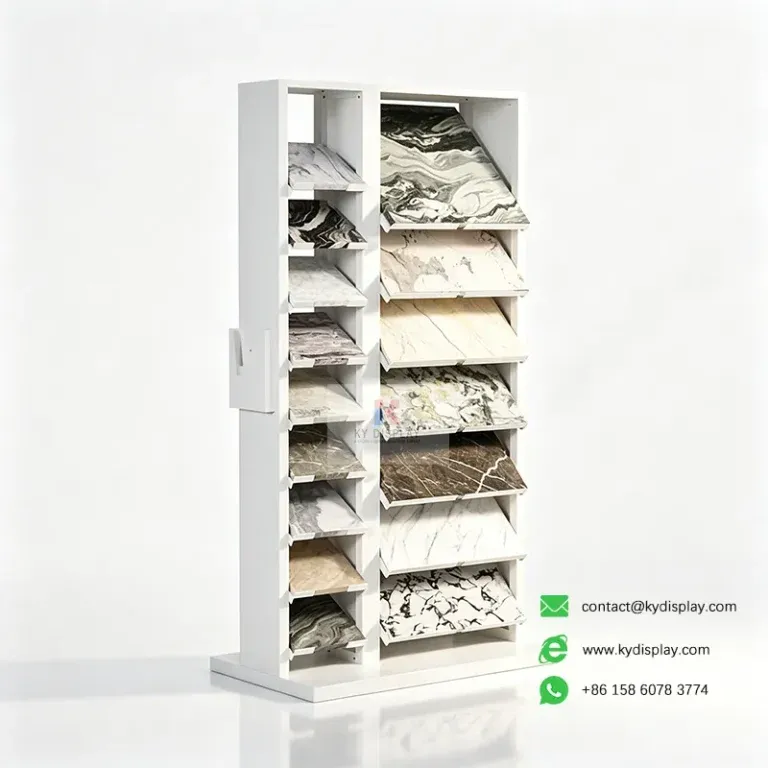
Decisions happen when two candidates stand next to each other. A tilted tile sample display rack presents sixteen slots at a reading angle, and two units back-to-back or side-by-side create a compare station where visitors shortlist without staff. Tilt also kills ceiling glare on glossy glazes, which is why flat walls make tile look either washed out or shiny. Keep the middle rows for best movers; the eye lands there first.
Layout 3: Hide the Deep Range in Pull-Out Cabinets
The floor should tell a story, not read like a warehouse. A push-pull display cabinet holds a hundred-plus references behind sliding panels, so visitors who want depth get it in seconds and the open floor stays curated. That split, story on the walls and catalog in the cabinets, is the single highest-impact change most stores can make.
Layout 4: Zone the Floor by Material, Not by Brand
Visitors arrive thinking “ceramic, porcelain, large-format, mosaic,” so the floor should speak that language. Give each material its own bay and its own rated fixture; a light-duty ceramic tile display rack suits thin swatches, while stone-look porcelain panels need steel carriers. Our ceramic tile display ideas guide details the ceramic bay. Loose zoning works best: a designer should be able to pull a mosaic next to a porcelain wood-look without crossing the store.
Layout 5: Give Large Formats Their Own Sliding Bay
Big panels cannot be judged on a chip rack. Dedicate a bay to a sliding large-format tile display system where 1200 x 2400 mm and bigger panels slide full-face, the only way a buyer can judge veining continuity across a counter run. Place the bay off the main path so sliding panels never block circulation.
Layout 6: Put a Touch Counter in Every Zone
Texture is what photos never carry. Add a low counter to each zone holding loose boards, mounted small formats and a mosaic plastic sample board for the detail materials. The closing flow is physical: see it on the wall, feel it on the counter, ask for the quote. Label every loose sample with finish and use case so the counter keeps selling when staff are busy.
Layout 7: Finish With Light, Signage and Wayfinding
Two overlays make the seven layouts read as one store. First, light: neutral 3500-4000K LEDs angled across faces, per the spec sheet in our showroom lighting guide. Color truth is what tile buyers trust. Second, wayfinding: zone signs at eye level and small “best seller” tags on tile showroom display stands so visitors self-navigate. For the full floor-plan logic, from aisle widths to sightlines and zone order, see our tile showroom layout guide.
Where to Find Tile Display Racks for Sale: What to Ask First
When you shortlist tile display racks for sale, five questions separate suppliers who sell fixtures from partners who sell outcomes: Can the slot size match your actual tile formats? Is the frame powder-coated steel or painted sheet? Do they provide a free 3D layout before production? What is the MOQ and lead time for a pilot order? And can logos and LED backlighting be integrated at the factory rather than added later? Our tile display rack buying guide covers each question in depth, and the same checklist applies to wood flooring showroom displays.
Get a Free Quote
Every display rack in these layouts is built to order at KY Display: your slot count, your tile size, your RAL color, your logo. Send us your floor dimensions and sample inventory and we return a free 3D layout within 24 hours. Get a free quote for OEM/ODM, factory-direct pricing and worldwide shipping.
Frequently Asked Questions
1. What is a showroom tile display rack?
It is the fixture that holds tile samples upright so visitors can browse, compare and shortlist without staff help. A good showroom tile display rack puts best movers at eye level, keeps the deep range in pull-out panels, and turns the floor into a guided path from entrance to quote.
2. How many tiles should a showroom display rack hold?
Curate, do not dump. A mid-size floor shows well with 100-300 samples on the racks and the full catalog behind pull-out panels or a digital kiosk. Every extra SKU on the wall lowers the visibility of the ranges you actually need to move.
3. What is the best display height for tile samples?
Keep best movers between 48 and 60 inches (about 120-150 cm) from the floor, the band where visitors compare without bending or reaching. Budget and specialty lines can sit above or below, but nothing popular should live at knee height.
4. Do ceramic and porcelain tiles need different display racks?
The hardware is largely the same; a ceramic tile display rack and a porcelain panel rack differ mainly in load rating. Thin ceramic swatches suit tilted or page-turning formats, while heavy porcelain and stone-look panels need steel carriers like pull-out cabinets or double-sided slab racks.
5. Can tile display racks be customized with our branding?
Yes. KY Display builds to order: slot count, tile size, frame color to any RAL code, removable logo headers and integrated LED backlighting. Every project starts with a free 3D layout fitted to your floor plan before production begins.
More Showroom Planning Guides
These 7 layouts are the fixture layer. For the plan behind them, read the tile showroom layout guide, add the lighting spec, then borrow cross-category ideas from the flooring showroom ideas guide. For fixture-by-fixture buying criteria, start with the tile display rack buying guide and the large-format sliding systems guide.