A STONE DISPLAY SOLUTION EXPERT !



The Complete Tile Display Rack Buying Guide 2026: Types, Costs & How to Choose the Right Supplier
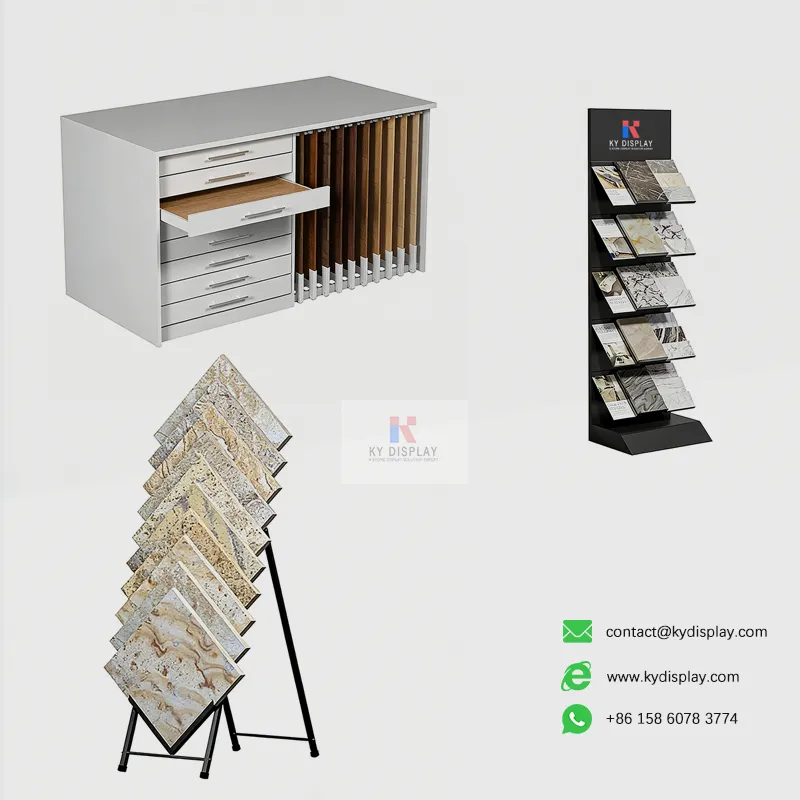
Table of Contents
This tile display rack buying guide explains what a tile display rack is: a fixture used by tile, stone, and flooring brands to present material samples—ceramic, porcelain, marble, granite, or wood—in showrooms, retail stores, and trade exhibitions. Unlike a warehouse shelf, a purpose-built display rack is engineered to maximize visibility, simplify side-by-side comparison, and turn browsing into buying. This guide compares the 7 most common rack types, breaks down real 2026 price ranges, and explains how to vet a manufacturer before you place a bulk order.
Key Takeaways
- There are 7 primary tile display rack types, from A-frame stands to digital-screen towers.
- Expect to pay USD 50-200 per unit for simple stands and USD 500-2,000+ for custom large-format sliding systems.
- 70% of purchase decisions are made at the point of sale—your display is a sales tool, not storage.
- Vet suppliers on export experience, customization, lead time, and real client cases—not price alone.
- KY Display offers free design plans with a 3–4 week production lead time.
What This Tile Display Rack Buying Guide Covers
This guide walks you through the 7 most common tile display rack types, a steel-vs-wood-vs-aluminum material breakdown, real 2026 price ranges, and a practical 5-point checklist for vetting a manufacturer before you order.
What Is a Tile Display Rack?
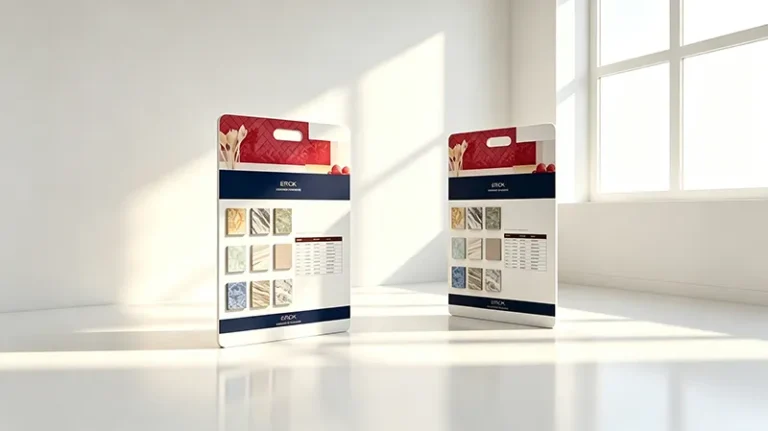
A tile display rack is a structure—typically steel, wood, or aluminum—that holds tile and stone samples at an angle or on a sliding/flipping mechanism so customers can view textures, sizes, and finishes without handling loose boxes. Professional racks are built to support heavy slabs (a 1200×2400 mm porcelain slab can weigh 40–60 kg) while occupying minimal floor space.
By the numbers:
- Standard racks hold 10–40 samples per unit
- Powder-coated steel frames last 2–3× longer than wood
- Well-designed showrooms using interactive racks report 20–35% higher closing rates
- Flat-packed shipping saves up to 40% in freight vs. assembled units
7 Types of Tile Display Racks Compared
| Type | Best For | Capacity | Price Range (USD) | Space Need |
| A-Frame Stand | Large-format slabs & tiles | 10 shelves | USD 80-250 | Low–Medium |
| Flip / Page-Turning Rack | Stone sample books, high capacity | 20–40 samples | USD 150-500 | Low |
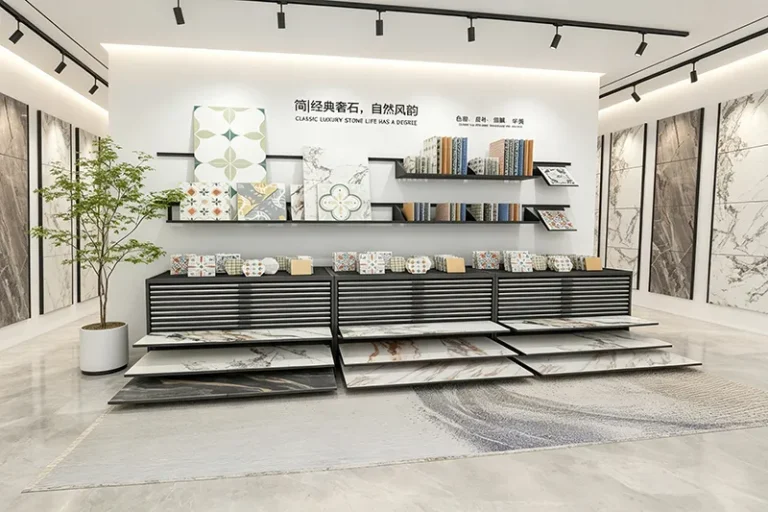
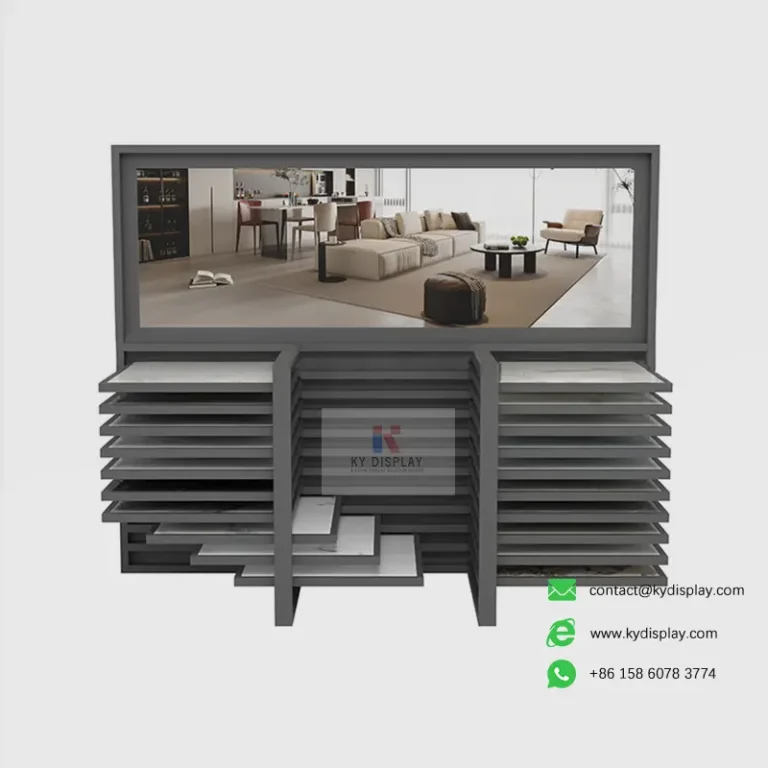
| Push-Pull Sliding Rack | Premium showrooms, smooth browsing | 6–12 panels | USD 300-1,200 | Medium |
| Pull-Out Drawer Cabinet | Luxurious, organized look | 10–30 drawers | USD 400-1,500 | Medium |
| Rotating Spinner (4-sided) | Small mosaics, 360° visibility | 20–60 samples | USD 120-400 | Low |
| Vertical Tower | Thin tiles, mosaic, small samples | 15–30 layers | USD 100-350 | Very Low |
| Digital-Screen Display | High-end, tech-enabled showrooms | 4–8 + screen | USD 800-2,000+ | Medium |
Tip: Match the rack to your sample size first. A 3200×1600 mm slab needs a steel-framed sliding system; a 300×300 mm mosaic is better on a rotating tower.
Steel vs Wood vs Aluminum: Which Material?
| Material | Durability | Visual | Maintenance | Best Use |
| Powder-coated Steel | High | Industrial / premium | Low | Heavy slabs, high-traffic showrooms |
| Aluminum Alloy | Medium–High | Modern, clean | Low | Design-forward retail |
| Wood / MDF | Medium | Warm, retail feel | Moderate | Boutique showrooms |
| Acrylic | Low | Boutique, light | Frequent | Countertop mini samples |
Rule of thumb: Stone and large-format porcelain need steel. Wood is fine for lightweight ceramic and LVT.
How Much Does a Tile Display Rack Cost in 2026?
Pricing depends on material, size, capacity, and customization. Based on current manufacturer listings:
- Simple metal stands (A-frame, spinner): USD 50-200 / unit
- Mid-tier sliding & flip racks: USD 150-600 / unit
- Custom large-format push-pull systems: USD 500-2,000+ / unit
- Digital-screen integrated displays: USD 800-2,000+ / unit
- Bulk order discount: Typically 10–30% off at 100+ units
Most suppliers require a sample order first (freight usually paid by buyer) so you can verify quality before committing to a bulk run.
How to Choose the Right Display Rack Supplier
Evaluate manufacturers on these 5 criteria:
- Export experience — Ensures smooth documentation and logistics (Incoterms, customs, container loading).
- Customization — Can they add your logo, match brand colors, and fit your tile dimensions?
- Lead time — Standard: 1–2 weeks for samples, 3–4 weeks for bulk. Confirm before signing.
- Real client cases — Ask for showroom photos, not renderings.
- Certifications — ISO 9001, load-bearing test reports, RoHS/CE for EU sales.
Frequently Asked Questions
What is a tile display rack used for?
A tile display rack presents ceramic, porcelain, stone, and wood flooring samples in showrooms and stores so customers can compare sizes, colors, and textures easily. It is a sales tool that improves browsing and conversion.
How many samples can a standard tile display rack hold?
Most standard racks hold 10–40 samples. Vertical towers and flip racks reach 30–60. Capacity depends on panel size and tier count.
How much does a tile display rack cost?
Simple metal stands run USD 50-200 per unit. Custom large-format sliding systems cost USD 500-2,000+. Bulk orders of 100+ units typically get 10–30% off.
What’s the difference between push-pull and sliding tile display racks?
Push-pull racks use panels you slide horizontally to reveal samples; sliding (drawer) racks pull out toward the user. Both save space—push-pull suits slab showrooms, drawers suit premium retail.
Can I get a sample before a bulk order?
Yes. Most suppliers offer samples (freight usually paid by buyer) so you can verify quality before committing to a bulk run.
What material is best for heavy stone slabs?
Powder-coated steel with reinforced bases. It supports 40–60 kg slabs and lasts 2–3× longer than wood.
How long does production take?
Samples: 1–2 weeks. Bulk orders: 3–4 weeks for most China factories; some suppliers quote 20–35 days.
Do display racks come with my logo?
Yes—OEM/ODM suppliers offer logo printing, custom colors, and branded signage. KY Display includes free design plans for this.
Are tile display racks flat-packed for shipping?
Most are. Flat-packed units cut freight by up to 40% vs. assembled racks and simplify container loading.
Which display rack is best for a small showroom?
Wall-mounted ledges, rotating towers, or A-frame stands maximize vertical space and need minimal floor area.
Conclusion
Choosing the right tile display rack is an investment in showroom conversion, not just storage. Start by matching rack type to your sample size, set a realistic budget using the price ranges above, and vet suppliers on export experience and customization—not price alone.
Ready to upgrade your showroom? Contact KY Display for a free design plan for our custom tile, stone, and flooring display racks.
Explore our related solutions like stone display rack or check inspiration on Pinterest.
Recommended Display Racks for Your Showroom
- Leaning Tile Display Rack – A-Frame 10-Shelf Stone Sample Stand
- Push Pull Laminate Flooring Display Rack – Double Sided Sliding Sample Cabinet
- Inclined Stone Display Stand – 5-Tier Slanted Vertical Sample Rack
- 4 Sided Spinner Display Stand – 360° Rotating Tile & Stone Sample Rack
- Contour Tile Display Tower – 3-Column 15-Layer Vertical Small Sample Stand
- Quartz Sample Display Rack – Double-Sided 5-Layer 10-Sample Vertical Stand