A STONE DISPLAY SOLUTION EXPERT !



9 Best Ceramic Tile Display Ideas for Showrooms
Table of Contents

Ceramic is the highest-volume tile category, yet most showrooms under-display it. Here is how to plan a ceramic tile display that sells — using the same fixture logic KYdisplay applies across tile, stone and mosaic.
What Is Ceramic Tile Display?
A ceramic tile display is the set of racks, boards and wall systems used to present ceramic and porcelain tiles in a showroom. Because ceramic spans floor, wall, and decorative lines in dozens of sizes and finishes, the display must handle high sample counts and easy comparison — not just a few hero pieces.
Why Ceramic Deserves Its Own Display Strategy
- Volume: ceramic is the most-specified tile category, so a thin display undersells the range.
- Variety: floor vs wall vs decorative lines need separate, labelled zones.
- Comparison: buyers choose ceramic by surface and size side by side — layout drives the sale.
Types of Ceramic Tile Displays
The tile-display market — led by Tsianfan (tiledisplayrack.net) and Yeks — organises ceramic displays by one practical axis: how the tile is presented to the buyer (standing full-size, flat in a drawer, on the wall, as a single sample, or as a slab). The families below are the real product lines showrooms actually spec, with the actual model formats behind each.
1 · Floor-standing racks — the core of a ceramic showroom
This is the category every supplier leads with, because ceramic is chosen by browsing the full-size tile. The market names the sub-types by the exact motion a salesperson uses to show one tile:
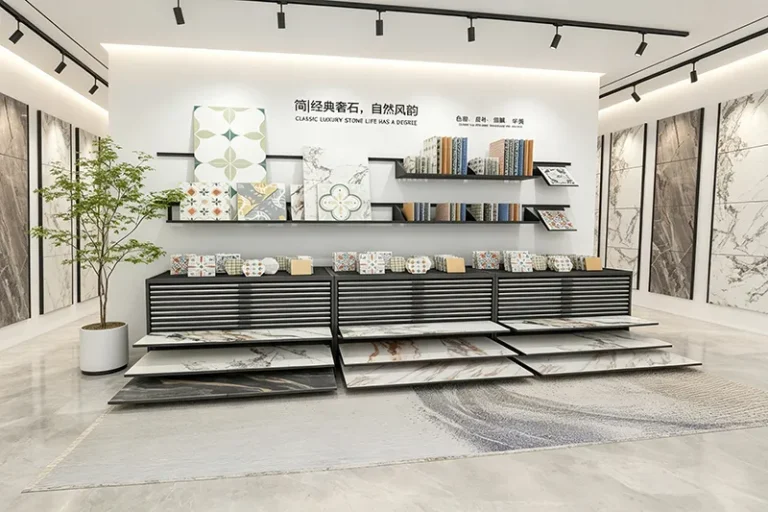
- Waterfall / step stands — tiles layered in overlapping tiers (Tsianfan SR017 “arched waterfall ceramic tile display stand”); reads like a finished wall, photo-ready for the showroom.
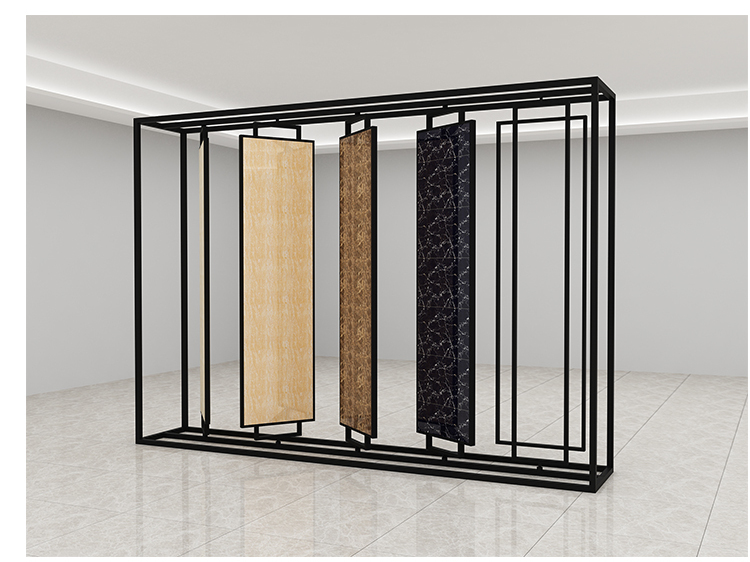
- Push-pull / pull-out racks — each tile sits in a tray that slides forward for inspection without lifting heavy neighbours (Yeks’ “sliding stone tile sample display rack”; Tsianfan’s “push-pull ceramic tiles flooring stand”). This is the format most showrooms pick for 600×600 and 800×800 floor tiles.
- Page-turning racks — tiles bound like book pages that flip; one person can leaf through a whole range in place.
- Rotating stands — a spinning column or turntable shows the full range from one spot (Tsianfan SG006 “countertops rotating display stand”, SRT657 “agate stone sample rotating table”).
- Sliding-partition / slot / modular-shelf units — simpler, lower-cost frames for high-volume self-browse (Tsianfan SG1006 “sliding partition tile display shelf”, CZ126 “black modular shelf”).
The spec that decides fit is slot pitch — one adjustable frame can carry 100×100 mm decorative pieces and 1200×2400 mm slabs. KYdisplay’s tile display rack family is built on 2.0 mm seamless steel, so ceramic, porcelain and stone share one modular inventory.
2 · Wall-mounted systems — turn a wall into a material library
Fix tiles to the wall on grids, rails or panel mounts — Tsianfan’s ZST003 “decorative edge sample showroom display system” and “ceramic tile bevel hole net display rack” are typical. They group ceramics by colour or finish into an immersive wall and free up floor space for large-format and decorative lines. The catch: a wall is a near-permanent install, harder to re-jig than a rack as the range changes.
3 · Drawer & cabinet displays — the protected back-catalogue
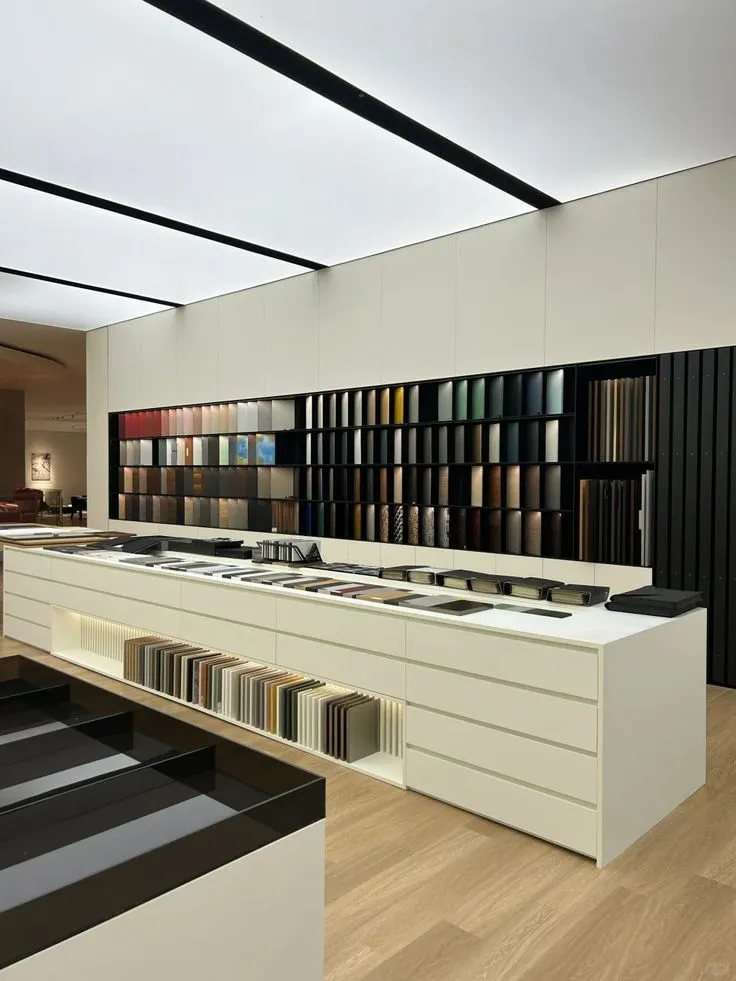
Where a rack shows tiles edge-on, a cabinet stores them flat in pull-out drawers — Yeks’ “Drawer Tile Sample Display Cabinet”, Tsianfan’s CC010 “tiled chest of drawers”. They protect fragile decorative and mosaic tiles, hide clutter, and pack a deep range into a small footprint. Trade-off: tiles are seen one drawer at a time, not all at once — so cabinets suit the full decor library while racks carry the heroes. KYdisplay builds cabinet and drawer units to order in the same 2.0 mm steel standard.
4 · Sample boards & swatch cards — the meeting tool
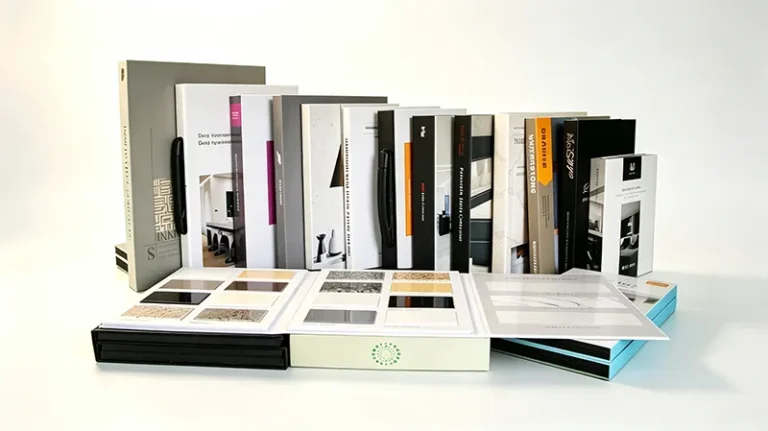
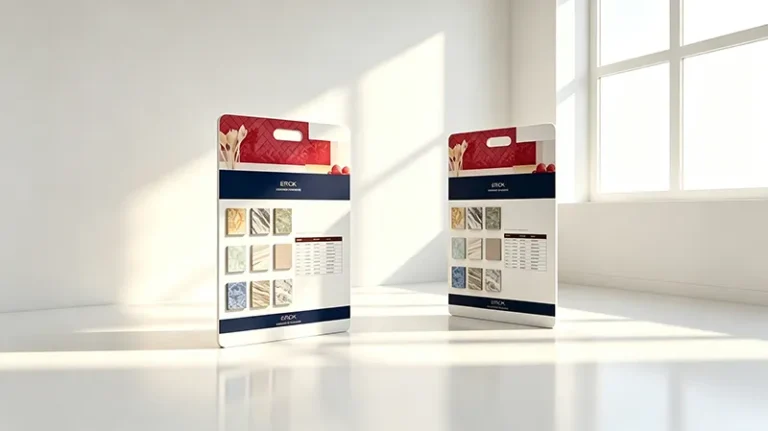
Both Yeks and Tsianfan sell MDF sample boards as a core line (Tsianfan’s PF005 series — PF005-4, PF005-21, PF005-71 double-sided). A board carries one ceramic — field tile or feature decor — in a recessed cavity or on an adhesive face, usually with a handle; Tsianfan also makes a portable “granite stone sample display suitcase” for client visits. For small-format and mosaic, Tsianfan’s “Ceramic Tiles Sample Plastic Book … 8 Capacity” binds several samples into a takeaway book — cheap, light, perfect for a client matching a tile to their kitchen, but only works for small pieces. KYdisplay builds handled boards for mosaic and stone sample boards. A board shows one or a few samples, so it is a sales-meeting tool, not a catalogue.
5 · Slab holder frames & transfer carts — for the big pieces
1200×2400 mm porcelain and sintered-stone slabs cannot stand safely, so the market uses dedicated slab holder frames and transfer carts (Tsianfan’s “Large Slab Holder Frame / Transfer Cart”). An A-frame holds the slab on edge for full viewing; a transfer cart moves it to a cut station. KYdisplay’s sliding large-format rack follows the same logic, letting staff slide a slab forward without lifting. Trade-off: slab frames occupy more floor per sample, so they are reserved for the largest pieces.
Key Features to Look For
- Adjustable slots: fit both small decorative and large floor tiles.
- Load capacity: porcelain is heavier — choose a frame rated for the range (KYdisplay uses 2.0 mm seamless steel as standard).
- Labelling: colour-coded tags so buyers self-navigate.
- Modularity: expand the wall or rack as the collection grows.
Ceramic Tile Display Ideas for Showrooms
- Group by material category and build a touch-and-feel counter — two of the ten principles in our tile showroom display ideas guide.
- Create a mix-and-match pairing wall so ceramic floor and wall tiles are seen together.
- Add oversized sample boards for feature ceramics, and a portable set for designer meetings.
- Pair the ceramic zone with a granite & quartz sample stand so adjacent materials share one showroom silo.
How to Choose the Right Ceramic Tile Display
Start from your range size: a few hero lines need a wall; a full catalogue needs modular racks plus boards. Then match slot size to your largest tile and confirm load rating for porcelain. Finally plan labelling and a consultation corner.For larger ceramic collections, choosing the right tile display systems can help balance sample capacity, showroom space, and customer access.
Customization & Branding
KYdisplay builds tile and stone display systems to order — size, material, colour, finish and logo. Because ceramic shares fixture logic with mosaic and stone lines, one custom system can serve the whole hard-surface showroom. Lead time: sample 1–2 weeks, mass production 3–4 weeks.
Frequently Asked Questions
What is the best way to display ceramic tiles in a showroom?
Group by material category, add a touch-and-feel counter and a mix-and-match pairing wall, then present the range on modular vertical racks plus oversized sample boards for feature lines — the same layout principles used for tile and stone showrooms.
How do ceramic and porcelain tile displays differ?
They use the same fixture family; porcelain is heavier, so the frame needs a higher load rating. Adjustable-slot racks built on 2.0 mm seamless steel handle both ceramic and porcelain sizes.
Can tile display systems be customized for ceramic collections?
Yes. KYdisplay builds tile and stone display systems to order — size, material, colour, finish and logo — so one custom setup can serve ceramic, mosaic and stone lines in the same showroom. Explore more Mosaic Tile Display Rack layout ideas on Pinterest for creative showroom design and modular sample stand inspiration.