A STONE DISPLAY SOLUTION EXPERT !



5 Best Stone Sample Display Stand Types: Which to Choose
A practical buyer’s guide to the five stand types — waterfall, spinner, A-frame, tower and flat insertion — mapped to KYdisplay’s real products and the showroom research that proves they sell.
Table of Contents
What Is a Stone Sample Display Stand
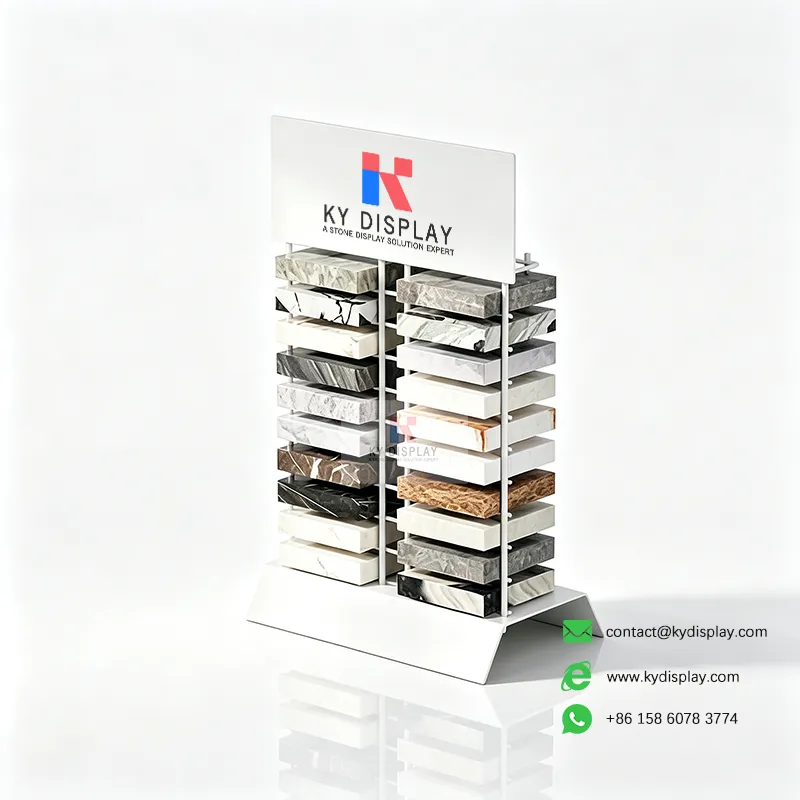
A stone sample display stand is a floor- or counter-standing fixture that presents stone material samples at a consistent, browsable angle so a showroom visitor can compare them hands-free. Where a loose offcut on a table forces the customer to pick it up, tilt it toward the light and guess at the rest of the stone, a stone sample display stand does the presenting for you: each sample sits secured, labelled and lit, turning a pile of remnants into a navigable material library.
KYdisplay’s own range spans the Inclined Waterfall Stone Display Stand, a 5-Tier Slanted Vertical Sample Rack, a 4-Sided Spinner, a Leaning A-Frame 10-Shelf Stone Sample Stand, a 12-Slot Flat Insertion stand and the Contour 3-Column Small Sample Stand (also listed as the 15-Layer Small Sample Tower) — each a different answer to the same question: how do you show stone so it actually sells.
Why a Stone Sample Display Stand Beats a Table of Loose Samples
Loose samples on a table read as leftover stock; a curated stand reads as a collection worth choosing from. That distinction is not cosmetic. NKBA‘s 2024 research found that only 6% of customers who visit a showroom leave without buying, that 7 in 10 homeowners consult a showroom, designer or contractor when starting a project, and that two-thirds of professionals report a conversion rate of 50% or higher (median 64%).
Most tellingly, in-store visits drive an average upgrade of +31% versus the customer’s initial selection. A stone sample display stand is the physical instrument of that +31%: it arranges your curated 30–50 samples for self-browse while the sales rep talks specification, lighting and price.
And because samples locked into a stand are physically safer than loose pieces on a table, you lose fewer to theft, chips and the dreaded “I’ll just take one home to check.” NKBA also reports that 60% of customers view a virtual showroom first — so a well-lit physical stand becomes the moment your digital funnel converts into a real, touchable decision. The stand is where the virtual tour ends and the sale begins.
The psychology is simple: a stone sample display stand tells the customer these materials are worth deciding between.
The 5 Stone Sample Display Stand Types (and the KY Product That Fits Each)
- Waterfall (hero pieces) — Inclined Waterfall Stone Display Stand. The waterfall style leans a single large sample forward at a dramatic angle, like a cascade of stone. Use it for hero materials: the two or three bookmatched marbles or granites you most want a client to fall in love with. KY’s Inclined Waterfall Stone Display Stand is the flagship of this category and has its own product page at inclined-stone-display-stand-2026.
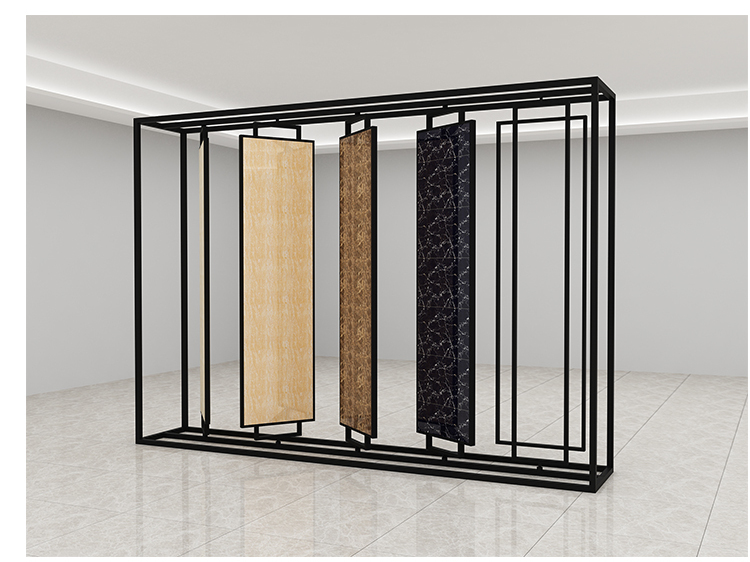
- Spinner (quick 360° scan) — 4-Sided Spinner. A spinner rotates so a customer can scan a full ring of samples with one hand. KY’s 4-Sided Spinner (stone sample) spins for a quick 360° scan, ideal at the entrance where traffic is high and attention is short.
- A-Frame (capacity in a small footprint) — Leaning A-Frame 10-Shelf Stone Sample Stand. The A-frame leans against the wall and stacks 10 shelves of material in a narrow floor profile. For a small fabricator worried about floor space and budget, this is the highest-density stand per square metre.
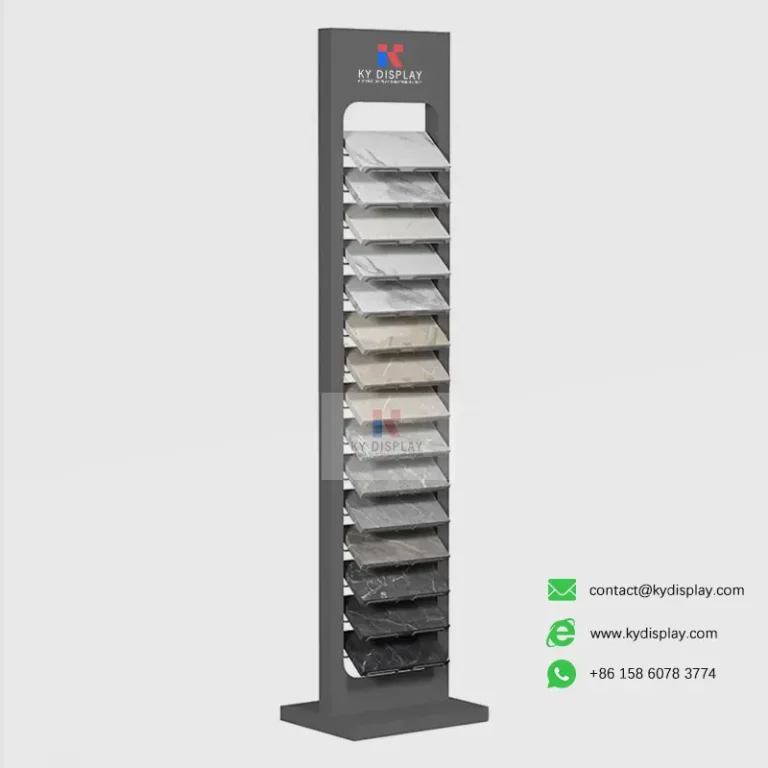
- Tower (many small samples) — Contour 3-Column Small Sample Stand / 15-Layer Small Sample Tower. When you need to show dozens of tiles or small samples, a vertical tower wins. KY’s 15-Layer Small Sample Tower stacks fifteen layers in three columns — a true small stone sample rack for compact counters.
- Flat insertion (small samples and tiles) — 12-Slot Flat Insertion stand. This stand holds samples vertically in slim slots, perfect for 250×250 mm tiles or thin samples. It’s the quiet workhorse beside the hero waterfall.
Beyond the five, KY’s 5-Tier Slanted Vertical Sample Rack gives a middle option — five slanted tiers for a medium material zone without committing to a full tower or a floor-hogging waterfall.
Capacity & Footprint Math: Match the Stand to Your Floor
Footprint anxiety is the number-one objection from small fabricators, so let’s put numbers on it. The market offers a victorstonedisplay tower that holds 30–80 colours, and quartzsampledisplay’s VQ104/VQ105 models hold 24 pieces of 250×250 mm — useful benchmarks for what “high capacity” looks like in the category.
Against those, KY’s Leaning A-Frame 10-Shelf Stone Sample Stand delivers ten full shelves in a leaning footprint that hugs the wall, while the 15-Layer Small Sample Tower packs fifteen layers into a column you can place against a counter. The rule of thumb: choose by footprint first, capacity second.
A spinner or A-frame earns its floor only if you have the traffic to justify it; a tower or flat-insertion rack earns its place wherever you need density without spread. This is why the right stone sample display stand is a floor-planning decision, not just a furniture purchase.
Think of it as rent per sample. A waterfall occupies prime floor for one or two heroes; an A-frame or tower earns its square footage by showing ten to fifteen materials in the same trace.
For a fabricator watching both margin and metreage, that math decides the buy. A stone sample display stand that fits your floor plan is worth more than a bigger one that blocks the aisle.
Curate 30–50 Samples, Zone by Material Family
Showroom studies from dynamicstonetools and slabwise are blunt about this: curate 30–50 samples rather than pile 200, because choice overload paralyzes the buyer. Vertical display beats flat, and you should zone by material family — granite, marble, quartz, porcelain — then order each zone light to dark and label every piece.
This is where the LSI product logic lives: a marble sample stand belongs in the marble zone, a granite sample display stand in the granite zone, and a quartz sample display in the quartz zone, each under its own lit header.
Your stone sample display stand is the delivery system for that curation; the stand type just decides how many materials each zone can hold. The choice paradox applies — three to five material options presented with context outperform a wall of ten shown without it.
A tidy zoned rack reads as expertise; a flat pile of 200 reads as a warehouse. You are not just displaying stone, you are editing it.
When you place a stone sample display stand in each material zone, the customer reads your expertise before a word is spoken.
Lighting & Guided Selling — the Highest-ROI Upgrade
Among every showroom principle, lighting returns the most per dollar. dynamicstonetools and slabwise rate lighting as the highest-ROI change you can make: daylight-rated 5000–6500 K light reveals true colour, while warm 2700–3000 K light sets an ambient, premium mood. Pair true-colour lighting with a stand and you get guided selling for free — the stand arranges the curated 30–50 samples for self-browse while the rep talks, exactly the mechanism behind NKBA’s +31% in-store upgrade.
A spinner at the door pulls traffic; a waterfall under true-colour light closes the hero sale. The stand is passive sales labour: it presents, it zones, it lights, and it never takes a commission.
For the fabricator, that is the quiet engine of the showroom. Mount the light so it grazes the face of each stone sample display stand at a true-colour temperature.
Durability & Theft: Why a Locked Stand Outsells Loose Samples
Samples are expensive inventory, and loose pieces walk. A stone sample display stand that holds samples in fixed slots keeps them on the floor, not in someone’s bag or car.
KY builds display furniture for daily showroom wear, and the locked-slot principle applies across the waterfall, A-frame, tower and flat-insertion lines: the sample stays put, stays clean, and stays sellable. For a fabricator watching margin, fewer lost samples is a direct, quiet profit line — and a stand that looks intact signals a business that takes its materials seriously.
A locked stone sample display stand therefore pays for itself in saved inventory alone.
How Big Should the Sample Be? (What Fabricators Actually Show)
Sample size is the silent driver of stand choice. Stone Business magazine’s “Showrooms: It Pays To Display” quotes real fabricators on the gap between a tiny chip and the real stone.
Chris Mian of Louis W. Mian notes a client will take a 4-inch sample, assume the whole stone matches, and the “result doesn’t match” — so he shows 12″×24″ or four-piece combo boards.
Rupesh Shah of MSI shows travertine at 3 ft × 5 ft and 3 ft × 3 ft. Northwestern in Chicago uses 12″×12″ samples.
The lesson for stand buyers: match the slot to the sample you actually sell. A flat-insertion or 12-slot stand suits 250×250 mm tiles and combo boards; a waterfall suits the large-format hero sample.
KY’s Mosaic Plastic Sample Board at 320×320 mm is a handy reference size for the smaller end of the range, and it pairs naturally with a small stone sample rack or countertop display.
How to Choose Your Stone Sample Display Stand — a Decision Framework
Start with four questions, then map each to a KY product:
- Footprint: how many square metres can you give the display? Small fabricator → A-frame or tower. Room to spare → waterfall + spinner.
- Traffic: high walk-in traffic → spinner at the door. Low, appointment-based → waterfall hero pieces.
- Material mix: mostly small tiles → tower or flat insertion. Mostly large samples → waterfall.
- Budget: entry → 5-Tier Slanted Vertical Sample Rack; scale → full zoned system of A-frame + tower + waterfall.
Map each KY product to a job and you can’t go wrong: Inclined Waterfall = hero pieces; 4-Sided Spinner = quick 360° scan; Leaning A-Frame 10-Shelf = capacity in a small footprint; 15-Layer Small Sample Tower = many small samples; 12-Slot Flat Insertion = small samples and tiles; 5-Tier Slanted Vertical = the medium middle. A marble sample stand, a granite sample display stand and a quartz sample display are not separate products — they are the same KY stands placed in three different material zones.
Customization, OEM/ODM & KYdisplay’s Free Showroom Design
Choosing the stand is half the work; laying it out is the other half. KYdisplay runs a 10,000 m² facility with 16+ years of custom display manufacturing, offers OEM/ODM and logo printing, and provides a free showroom design service so your zoned layout is planned before a single stand ships.
Handheld sample boards carry an MOQ of 500 units, with sample lead time of 1–2 weeks and mass production of 3–4 weeks after design approval. Before you order, sketch the layout of each stone sample display stand on your floor plan.
Explore the real lines — the full stone display collection, the standing display rack range, the countertop display rack range, the dedicated Inclined Stone Display Stand 2026 page, and the mosaic display boards with handle — and pair this article with our sibling guides on the stone sample book and the stone sample board. Learn more about KYdisplay.
To recap: a stone sample display stand is the single most portable, most persuasive tool a stone seller can use, and the right stone sample display stand is what turns a client meeting into a signed order. For full showroom coverage, pair it with stone sample book and stone sample board so the whole stone range is presented consistently.
Frequently Asked Questions
What is a stone sample display stand?
A stone sample display stand is a floor- or counter-standing fixture that holds stone samples — tiles, small samples or combo boards — at a consistent, browsable, lit angle so showroom visitors can compare materials hands-free. KYdisplay’s range includes waterfall, spinner, A-frame, tower and flat-insertion styles.
Which stone sample display stand type holds the most samples?
For raw count, a tower or high-capacity rack wins — the market offers towers holding 30–80 colours (victorstonedisplay) and 24 pieces of 250×250 mm (quartzsampledisplay VQ104/VQ105). Within KY’s line, the 15-Layer Small Sample Tower and Leaning A-Frame 10-Shelf stand deliver the most samples per footprint.
What is the difference between a waterfall and a flat insertion stand?
A waterfall stand leans one large hero sample forward at a dramatic angle to showcase a flagship material; a flat insertion stand holds many slim samples — tiles or small samples — vertically in slots for high-density browsing. Use the waterfall for hero pieces, flat insertion for 250×250 mm tiles and combo boards.
How many stone samples should I put on display?
Curate 30–50 samples rather than piling 200 — showroom research from dynamicstonetools and slabwise shows choice overload paralyzes buyers. Zone them by material family (granite, marble, quartz, porcelain), order light to dark, and label each.
Can a stone sample display stand be customized with my logo?
Yes. KYdisplay offers OEM/ODM, logo printing and full custom display manufacturing from a 10,000 m² facility with 16+ years of experience, plus a free showroom design service. Handheld sample boards start at MOQ 500 units; sample lead is 1–2 weeks, mass production 3–4 weeks.
What lighting should I use with a stone sample display stand?
Lighting is the highest-ROI upgrade. Use daylight-rated 5000–6500 K light for true colour and warm 2700–3000 K light for ambiance, per dynamicstonetools and slabwise. True-colour light on a hero waterfall underpins the guided-selling that drives NKBA’s +31% in-store upgrade.