A STONE DISPLAY SOLUTION EXPERT !



Top 10 Stunning Marble Sample Book Ideas: Expert Tips
Table of Contents
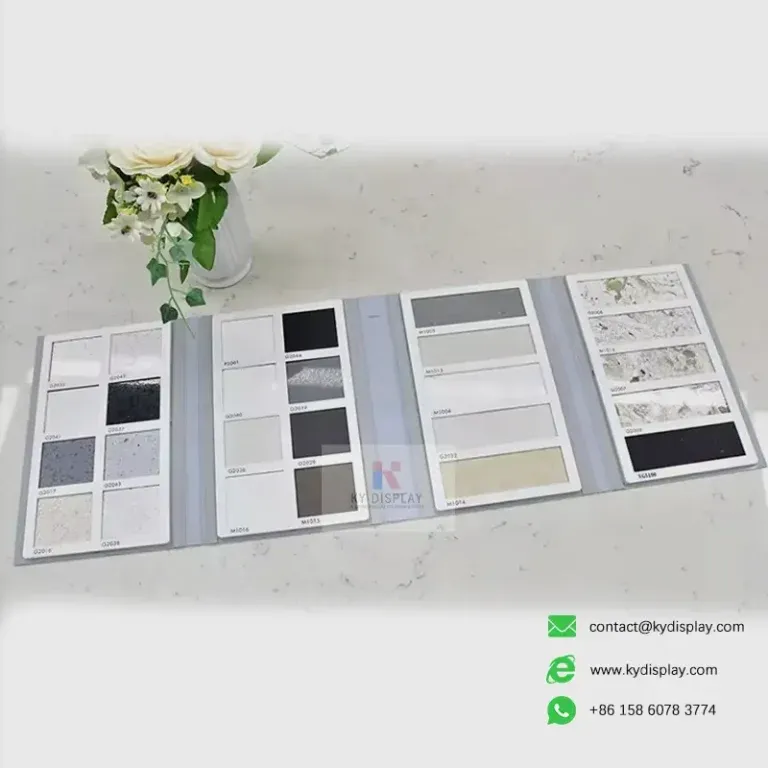
A marble sample book is a bound, portable catalog of real marble chips arranged so a client can see how a vein travels, not just what a colour looks like on its own. It exists to answer the question every marble buyer actually asks: will the slab look like this?
Who this is for: stone importers, fabricators, tile and stone distributors and showroom owners selling natural marble. Most present to designers and contractors who will not accept a colour name as proof.
Why a Marble Sample Book Sells Veining Better Than a Chip
A marble sample book is necessary because small samples under-represent marble. The value sits in movement, and a 4-inch chip can capture one vein or none at all. Fabricators have made this point openly in trade press: a client picks up a small sample, assumes the whole slab looks like that, and when it does not, the fabricator absorbs the disappointment.
Three marble families behave differently, which is why zoning matters. Carrara reads as a soft white or grey base with fine, quiet veining. Calacatta carries bold, dramatic veins on a brighter white ground. Statuario sits between them, with striking grey pattern over a luminous base. Put them in one undifferentiated stack and the client cannot tell which is which.
10 Marble Sample Book Ideas That Sell Stone
1. Book-Matched Chip Sequences
Mount two or three consecutive chips from the same block side by side and number them. This shows the vein continuing across pieces, which is the detail that sells book-matched feature walls and islands.
2. Zone by Marble Family
Keep Carrara, Calacatta and Statuario in separate labelled sections, then order light to dark inside each zone. The eye moves through the range instead of jumping, which is how a marble sample book earns its keep.
3. Size Chips for Vein, Not for Count
Chip size is a direct trade-off against capacity. Compact chips around 43 by 88 mm let a book carry roughly 48 references, while larger chips around 180 by 60 mm suit a tighter premium line at about 32. If veining is your selling point, spend the space on fewer, larger chips. Treat both figures as industry reference.
4. Finish Pair on Every Page
Show polished and honed side by side for the same stone. Finish changes how a vein reads almost as much as the stone itself does, and clients rarely understand that until they see both.
5. Slab Reference Photo Behind the Chip
Print a small full-slab image beside each chip. The chip proves the material, and the photo proves the scale.
6. Origin and Application Label
Label name, origin, finish and recommended use on every chip. Unlabelled samples turn every page into staff narration.
7. Honest Variation Note
Marble is natural and no two blocks match. Print a line stating that chips are representative. This single note prevents most “this is not what I picked” disputes.
8. Leave-Behind Second Run
Produce a second run for designers to keep. A marble sample book left on the client’s desk keeps working after the meeting ends.
9. Hard Cover With Your Logo
Covers take embossing, debossing or foil stamping. A logo tells the client they are dealing with a real supplier rather than a marketplace listing.
10. Board Companion
Pair the book with a full-size board. The book narrows the choice, and the board confirms it at the size the stone will actually be installed.
How to Curate a Marble Sample Book
Curation beats coverage. A curated selection of roughly 30 to 50 chips outsells an exhaustive catalog, because too much choice slows buyers rather than persuading them. Label everything, zone by family, and keep the sequence identical from book to book so staff can find a chip without thinking.
Lighting decides whether the marble looks like itself. Daylight-balanced light around 5000 to 6500 K shows true colour, while warm light near 2700 to 3000 K flatters and misleads. Present under the light the client will live with, and treat the figure as industry reference.
Three Mistakes to Avoid
Choosing chip size before deciding what the book is for. Mixing marble families inside one section. Showing a chip with no scale reference anywhere on the page.
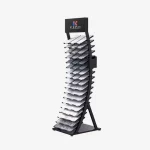
For natural stone terminology and care guidance, the Natural Stone Institute publishes reference material the trade uses, and Coverings is where the stone and tile industry reviews new presentation systems. KYDISPLAY builds OEM/ODM marble sample book formats and marble sample displays to your chip size, capacity and logo, alongside marble display racks for showrooms. Start a specification through the custom display rack page.
Frequently Asked Questions
What is a marble sample book?
A bound, portable catalog of real marble chips arranged by family and finish so a client can judge veining, colour and scale before committing to a slab.
Why is a 4-inch marble chip misleading?
Marble’s character is movement. A small chip can show a single vein or none, so it cannot represent how a slab will read across a wall or an island.
What does book-matching mean in a sample book?
It means mounting consecutive chips from the same block in order and numbering them, so the vein visibly continues from one piece to the next.
How many chips should a marble sample book hold?
A curated 30 to 50 sells better than an exhaustive list. Capacity depends on chip size: roughly 48 compact chips or about 32 larger ones, as an industry reference.
Should I show polished and honed together?
Yes. Finish changes how veining reads, and clients rarely predict that difference until both are in front of them.
What lighting should I present marble under?
Daylight-balanced light around 5000 to 6500 K shows true colour. Warm light near 2700 to 3000 K flatters and misleads, so present under the light the client will live with.
Can a marble sample book carry my logo?
Yes. Covers take embossing, debossing or foil stamping, with custom colours and printed divider pages as standard options.