A STONE DISPLAY SOLUTION EXPERT !



Quartz Sample Display Tower: 5 Types That Turn Samples Into Sales
Table of Contents
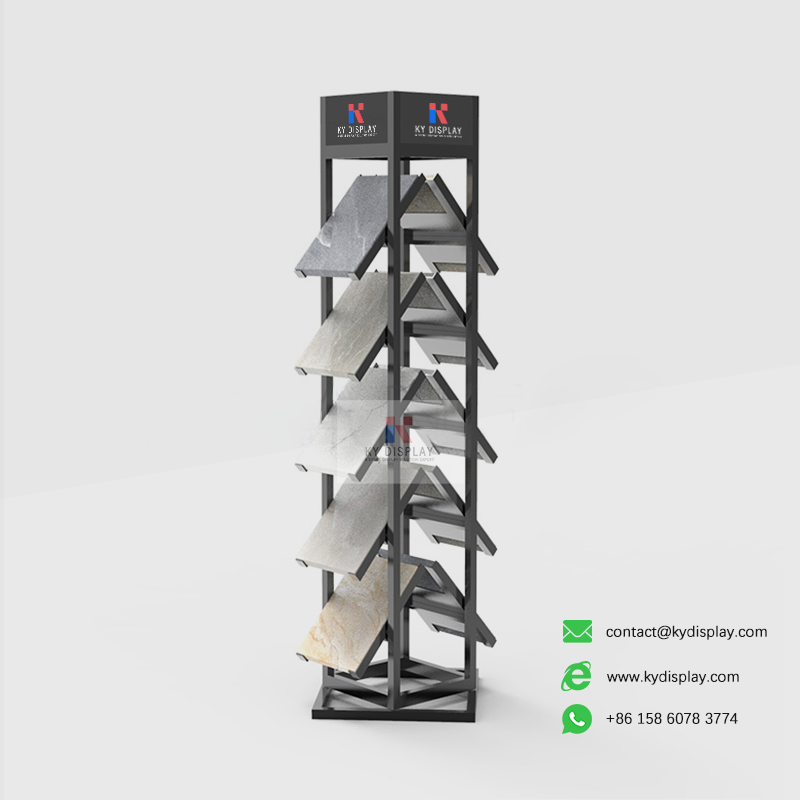
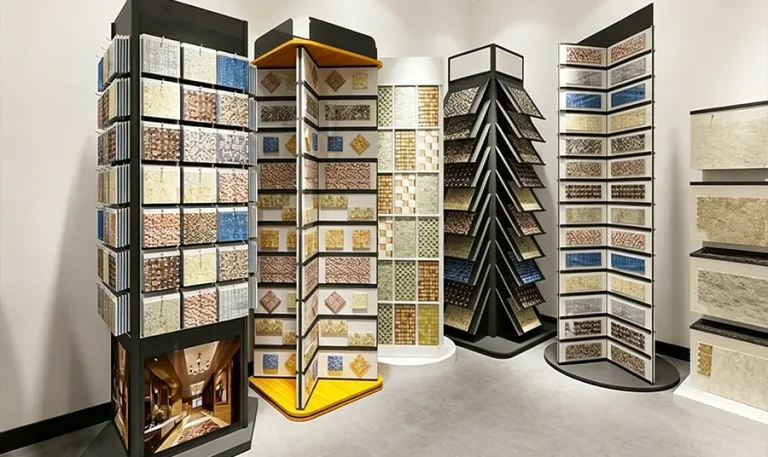
Quartz is a color business. A distributor who shows forty colors well outsells one who shows two hundred badly, and the fixture doing that work is the quartz sample display tower. Get the rack right and buyers flip, compare and shortlist on their own; get it wrong and your premium colors sit in a drawer. At Coverings, the largest tile and stone show in North America, the booths that stop traffic all solve the same problem: dense color ranges presented so the eye can scan and the hand can pull. This guide breaks that problem into 5 rack types you can buy off the shelf or customize.
| Type | Best For | Footprint |
|---|---|---|
| Countertop single-row rack | Reception desks, trade-show tables | Fits any counter |
| Double-sided slab rack | Main floor, full-range browsing | Freestanding center aisle |
| Arched floor tower | Hero collections, entrance drama | Small vertical footprint |
| Inclined tiered stand | Color-gradient walls | Wall or back-to-back |
| Single-slab hero holder | Flagship colors, design studios | Tabletop or counter |
Quartz sample display tower: What It Is and Why It Sells
A quartz sample display tower is a steel or MDF fixture engineered around one awkward fact: quartz samples are heavy, polished, and all look alike at first glance. The rack has to hold them upright at an angle that kills glare, keep every colorway pullable with one hand, and make the range look curated rather than stacked. Stone-industry bodies such as the Natural Stone Institute have long made the same point about natural stone presentation — the material sells on surface and light, so the fixture must serve both.
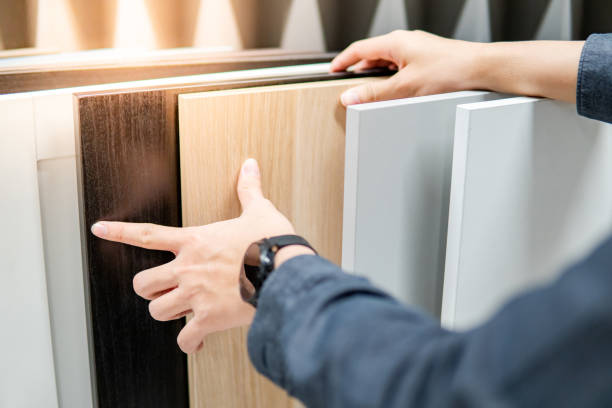
For an engineered-stone brand the payoff is measurable. A well-sorted rack lets a buyer walk a full color library in two minutes, pull four candidates, and ask for a quote — instead of waiting for staff to fetch swatches. That is why distributors treat the rack as sales equipment, not storage.
Type 1 — Countertop Single-Row Rack: The 22-Slot Workhorse
Where floor space is zero, the counter does the selling. KY Display’s quartz countertop display stand holds up to 22 samples in a single row on a 500 x 500 x 395 mm footprint, built from 2.0 mm cold-rolled steel with slots sized for 100 x 200 mm or 200 x 200 mm swatches. The detail that moves it from useful to persuasive is the printed kitchen backdrop: buyers see the color exactly where it will live — on a counter — instead of on a bare shelf. The backdrop ships with a realistic kitchen scene or accepts your own render, and the frame can be powder-coated to any RAL color to match your brand.
Type 2 — Double-Sided Slab Rack: The Main-Floor Range Builder
When the range has to fill the main floor, go double-sided. KY Display’s dedicated quartz sample display rack is a double-sided 5-layer vertical stand for 10 samples, so two shoppers browse opposite faces at once and the tower divides your aisle instead of crowding a wall. For mixed stone libraries that also include full slabs, the double-sided 4-panel slab display rack extends the same logic to 16 slab panels. This is the format for distributors whose buyers arrive with a shortlist and leave with a wider one.
Type 3 — Arched Floor Tower: The Entrance Statement
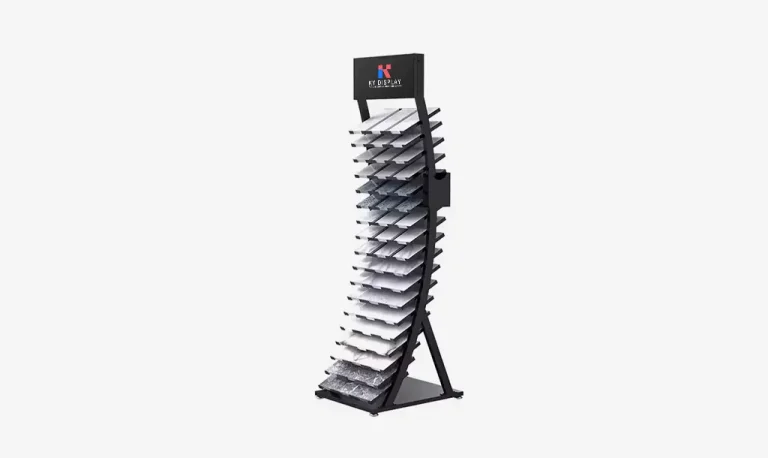
An arched top single-sided stone display rack earns its floor spot by framing the samples like a storefront window. Use it for your hero collection: the arch draws the eye from the door, the vertical stack keeps every colorway at browsing height, and the small base footprint lets it anchor an entrance without blocking flow. When you need two dozen colors on one small footprint instead, the stone display tower rack holds 24 quartz and granite samples in a single vertical column. One tower per brand story is enough — its job is to stop traffic, not to hold the whole range.
Type 4 — Inclined Tiered Stand: The Gradient Wall
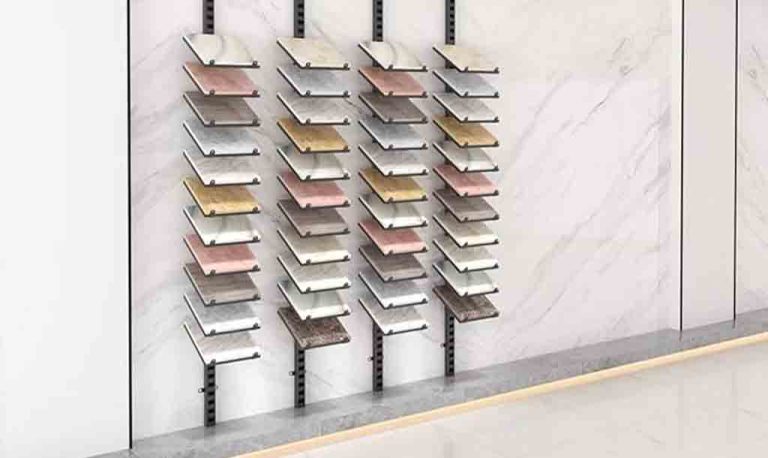
Quartz sells in gradients — whites into greys into blacks, calm into dramatic veining. An inclined five-tier display stand presents five rows at a slanted angle that reads as one continuous ramp of color, which is the fastest way to make a 60-colorway line feel organized. Sort rows by tone and finish, keep the best movers on the middle tier at eye level, and the rack quietly does your merchandising.
Type 5 — Single-Slab Hero Holder: The Design-Studio Closer
Some sales are won one color at a time. A custom stone sample holder for a single 40 mm slab puts your flagship quartz upright on a counter or studio table with a logo-branded base — the format fabricators and designers use when the conversation is about one specific kitchen. Pair it with the double-column countertop rack and a removable logo header when the meeting needs a dozen candidates instead of one.
How to Choose the Right Quartz Display Rack
Four decisions narrow the field fast:
- Sample format. Thin swatches (100 x 200 mm) belong in high-capacity chip rows; larger sample boards belong in tiered vertical carriers. Match the rack to what you actually ship to buyers.
- Capacity versus clutter. A 22-slot countertop unit that is fully stocked outsells a tower that hides half its range behind poor sorting — plan capacity around your real colorway count.
- Branding surface. Backdrops, logo headers and RAL-matched frames turn a fixture into a brand asset; ask for a printed kitchen scene or supply your own render.
- Commercials. Confirm MOQ flexibility for a pilot order, sample lead time before mass production, and knock-down export packing — KY Display works on a 100-unit MOQ, 7-12 day samples and 3-4 week production.
Quartz Sample Display Tower vs Granite Sample Display Rack
Buyers often ask whether the two need different fixtures. The honest answer: the hardware platforms overlap heavily, because a granite sample display rack and its quartz cousin both solve heavy-stone presentation. The difference is in the mix. Quartz lines run deep on uniform swatches, so high-capacity chip rows and gradient tiering pay off; granite lines mix tiles with slabs, so slab carriers carry more of the load. If you sell both, buy one rack platform and specify two branding skins — our stone sample display stand types guide maps the shared formats, and the quartz display rack wholesale guide covers the quartz-specific buying questions.
Where Your Quartz Sample Display Stand Works Hardest
Placement decides payback. A quartz sample display stand — like the arc-shaped quartz sample display stand — earns its keep in four spots: the reception counter (Type 1, where every visitor passes), the main aisle (Type 2, where ranges get compared), the entrance (Type 3, where stories start) and the meeting table (Type 5, where deals close). Light them properly — neutral 3500-4000K LEDs, angled to kill glare on polished surfaces, as covered in our showroom lighting guide — and keep a curated stone sample book on the counter for leave-behinds. Do those four placements well and the rest of the floor can stay simple.
Get a Free Quote
Every quartz sample display tower in this guide is built to order in KY Display’s 10,000 m² facility: your slot count, your RAL color, your backdrop, your logo. Send us your sample sizes and showroom dimensions and we return a free 3D layout within 24 hours. Get a free quote for your quartz line — sample lead time 7-12 days, production 3-4 weeks, worldwide shipping.
Frequently Asked Questions
1. What is a quartz sample display tower?
It is a vertical fixture that presents a full quartz color range in a tall, small-footprint column, so buyers compare colors and finishes side by side without giving up floor space. Formats range from a 22-slot quartz countertop display stand for reception desks to double-sided five-layer towers — the right choice depends on your sample size and floor space.
2. What sample sizes does it hold?
Most countertop racks hold 100 x 200 mm or 200 x 200 mm swatches — the KY Display 22-slot unit, for example, is sized exactly for these chips. Five-layer towers carry larger sample boards on every tier, and for the occasional full-slab viewing a dedicated single-slab holder steps in.
3. How is a quartz sample display tower different from a granite sample display rack?
The hardware is largely the same — both hold heavy, polished stone samples upright — but quartz collections usually run 30-60 colorways of thin swatches, while granite lines mix slabs and tiles. A granite sample display rack therefore leans on slab carriers, while quartz leans on high-capacity chip rows with a branded backdrop.
4. Can the rack be customized with our brand?
Yes. KY Display builds every rack to order: slot count, frame color to any RAL code, laser or removable logo header, and a printed backdrop scene you can supply or have designed — so the fixture sells your brand, not a generic look.
5. What is the MOQ and lead time?
KY Display works with a 100-unit MOQ that stays flexible for pilot collaborations. Sample lead time is 7-12 days, mass production 3-4 weeks after design approval, and every unit ships knock-down in export cartons on wooden pallets.
More Quartz and Stone Display Guides
Building out the whole stone category? Start with our 5 stone sample display stand types, then the quartz display rack wholesale guide for procurement detail and the stone sample book curation guide for the leave-behind format. For the light that makes polished quartz read true, see the tile showroom lighting guide — the same LED rules apply.