A STONE DISPLAY SOLUTION EXPERT !



Stone Slab Display Rack Buying Guide 2026: 5 Best Tips
Table of Contents
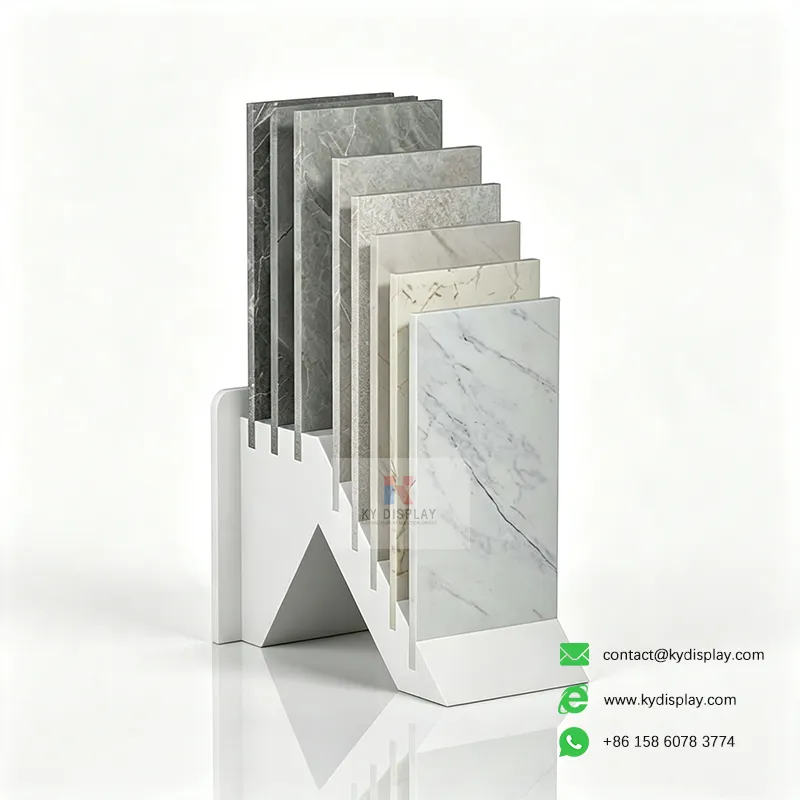
A stone slab display rack is a floor or countertop fixture built to hold heavy stone samples — marble, quartz, granite — at a viewable angle without risking chips or falls. Buying the right one protects expensive material and turns a quiet corner into a selling zone.
This 2026 guide is written for importers, wholesalers, and showroom owners who specify fixtures for their own sales floors (or for resale), and it follows the same “define-before-you-buy” method leading stone-rack manufacturers recommend to their B2B buyers.
Market context (industry reference): the global stone slab display rack market runs in the hundreds of millions of USD and is projected at roughly 5–7% CAGR over five years. Asia-Pacific dominates manufacturing (China >60% of global supply); North America and Europe are the largest consumption markets. The takeaway for buyers: you have many Chinese OEM/ODM options — the differentiator is specification discipline, not availability.
What Is a Stone Slab Display Rack (and Why It Matters)
A stone slab display rack presents slabs or samples in an organized, accessible arrangement. Unlike a warehouse storage rack — where the main objective is storage density and rated load — a showroom display rack must also deliver customer visibility, surface presentation, easy comparison, and clean traffic flow. Start from your showroom layout, not from generic “heavy duty” claims.
Step 1 — Define These 7 Things Before You Shop
- Maximum slab dimensions (length × height × thickness)
- Number of slabs/samples to display at once
- Available floor area for the rack zone
- Display orientation — vertical, horizontal, pull-out, or sample board
- Viewing requirement — full-slab viewing or compact sample comparison
- Handling method — manual, forklift, crane, or lifter
- Rated configuration — the actual capacity and loading condition of the chosen model
Stone Slab Display Rack Types
- A-Frame / stepped ladder rack — leans slabs in steps on a counter or floor. Our A-Frame Stone Display Stand – Stepped Ladder Countertop Sample Rack is a portable example for desks and consultation tables.
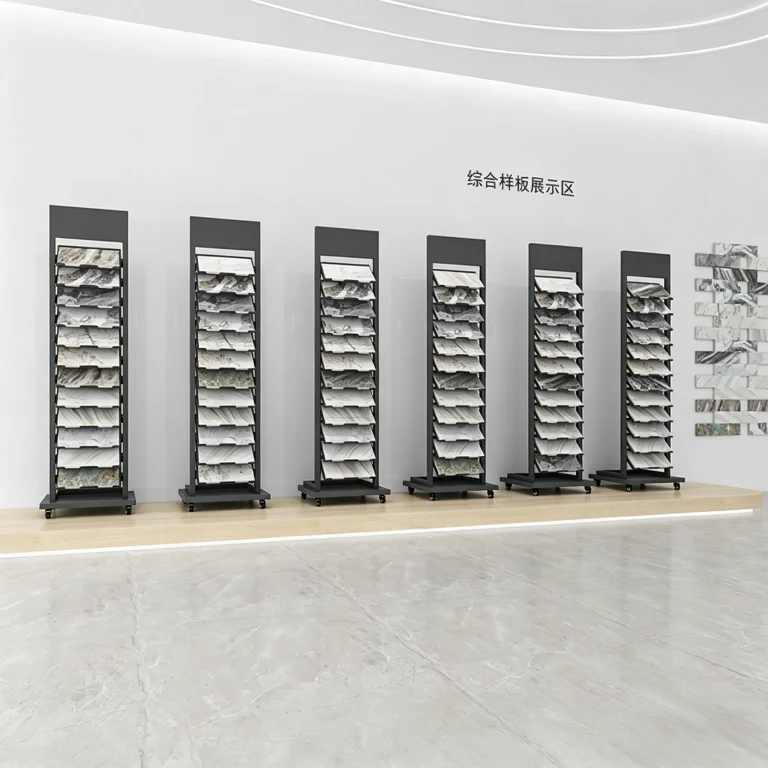
- Floor-standing single-sided tower — vertical tower for full slab faces. The Arched Top Single-Sided Stone Display Rack – Floor Standing Sample Tower shows slabs at standing eye level with a branded arch top.
- Double-sided panel rack — slabs back-to-back. The Double Sided 4 Panel Slab Display Rack – 16-Slab Freestanding Showroom Stand holds 16 slabs in a small footprint, ideal for slab yards.
- Countertop single-sample holder — the Stone Slab Display Stand – 40mm Single-Sample Floor Holder with Logo Base presents one hero slab with a logo base for meetings.
Materials: Steel vs MDF (and Why It Matters to Buyers)
Most commercial racks use seamless steel frames with powder coating for load and durability, paired with MDF or rubber-lined trays to protect polished faces. Steel carries the weight; lined trays prevent micro-scratches on marble. For dust-prone or humid environments, specify stainless-steel bearings and sealed components.

Key Specs to Check (the Ones Buyers Regret Skipping)
- Load capacity per tier: size to your heaviest slab, not your lightest. Commercial-grade units commonly rate 800–1200 kg per unit (industry reference); spec a 20% safety margin above your heaviest slab.
- Slab size range: confirm max width/height; large-format porcelain and quartz need wider frames.
- Slot pitch: tighter pitch fits more thin boards; wider pitch protects heavy stones.
- Base stability: a low, heavy base prevents tip-over in high-traffic showrooms.
- Certification: GS/CE for structural safety where required by your market.
- Sample visibility: aim for 70–90% visibility without removing the sample.
- Mechanism durability: request evidence of smooth operation across 5,000+ test cycles for sliding/rotating hardware.
Match the Rack to the Stone
| Stone | Recommendation |
|---|---|
| Marble | Slanted/tilted rack with rubber-lined pads; gentle tilt ~15–20° to protect soft face and show veining |
| Quartz | Reinforced vertical or A-frame; low heavy base (quartz >100 kg/㎡) |
| Granite | Strong slotted rack; heaviest tiers at bottom |
Common Buying Mistakes (Real Buyer Audits)
- Sizing tiers to the lightest sample, then overloading with granite.
- Skipping padded dividers — polished marble etches and scratches on bare steel.
- Ignoring loaded slab dimensions (the empty rack “fits” but the installed slab needs clearance).
- Skipping the logo header — a branded base turns a generic rack into a memory trigger for importers.
Factory Due-Diligence Checklist (OEM/ODM Buyers)
Before you commit a PO, request: load-test records, surface-finish QC docs, and packing drop-test results. The real friction importers report is rarely product choice — it is packing quality, lead-time reliability, and how fast a display can be refreshed for new collections.
Showroom buyers tracking material trends can reference Coverings for tile and stone retail education, and BAU Munich for building-material systems and standards.
Frequently Asked Questions
What is a stone slab display rack?
It is a fixture built to hold heavy stone samples like marble, quartz, and granite at a safe, viewable angle for showroom comparison.
How many slabs does a showroom rack hold?
Typical floor racks hold 12–40 slabs depending on type and pitch; double-sided panel racks reach 16 slabs in a compact footprint (confirm per model).
Which rack is best for marble?
A slanted or tilted rack with rubber-lined pads and a gentle 15–20° tilt protects the soft face and shows veining clearly.
Can one rack hold marble and granite together?
Yes, but size every tier to the heavier stone and keep softer marble on gentler upper rows.
What material should a stone rack be made of?
Seamless steel frames with powder coating for strength, plus lined MDF or rubber trays to protect polished surfaces.
Where do I order a custom stone slab display rack?
KYDISPLAY manufactures OEM/ODM stone slab racks with your dimensions, logo, and finish via its custom display quote page.