A STONE DISPLAY SOLUTION EXPERT !



Customizable Stone Display Stands: 7 Effective Options
Table of Contents
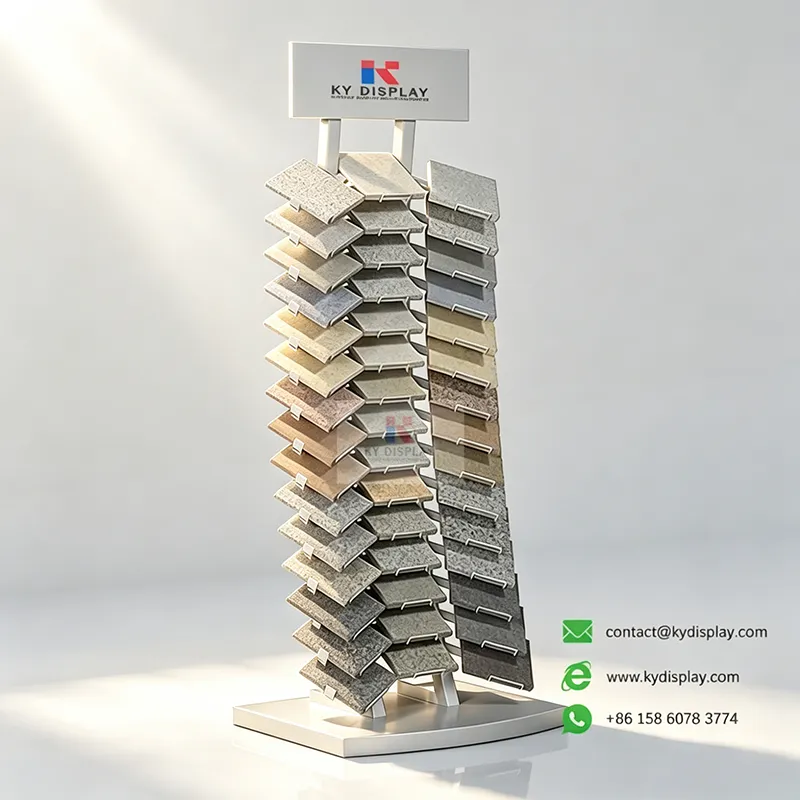
Customizable stone display stands help stone suppliers, distributors, showroom operators, and material brands present quartz, granite, marble, and engineered-stone samples in a clear, organized format. The right display should match the sample size, thickness, weight, quantity, available space, and way customers need to view or handle the samples.
For B2B buyers, the best approach is to start with the samples and showroom requirements rather than choosing a standard rack first. A custom display can then be designed around the required capacity, slot spacing, display angle, footprint, finish, branding, and other project specifications.
What Makes a Stone Display Stand Customizable?
A customizable stone display stand is a display fixture that can be adapted to specific sample and showroom requirements. Depending on the project, the structure may be floor-standing, countertop, wall-mounted, inclined, rotating, double-sided, or designed for direct sample insertion.
Common materials include:
- Quartz
- Granite
- Marble
- Engineered stone
- Natural stone
- Travertine
- Terrazzo and other architectural surfaces
The main customization points are usually overall dimensions, sample dimensions, thickness, capacity, slot spacing, display angle, material, color, logo placement, signage, and mobility.
For the complete range of B2B stone display systems, see our stone display rack manufacturer and wholesale supplier page.
7 Types of Customizable Stone Display Stands
1. Vertical Flat-Insertion Stone Display Stand
A vertical flat-insertion design places samples into individual slots in an upright structure. It is a practical option when the showroom needs a large number of samples in a relatively small footprint.
This format works especially well for smaller quartz, granite, marble, and engineered-stone samples. The slot count and spacing can be changed according to the actual sample dimensions and thickness.
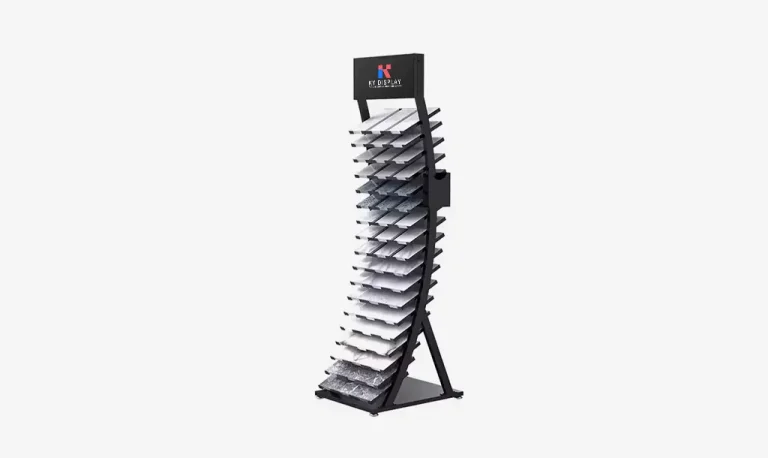
For example, KYDISPLAY’s quartz, granite and marble display stand uses a 12-slot vertical flat-insertion structure and can be customized in overall dimensions, slot spacing, color, branding, and mobility.
2. Inclined Stone Display Stand
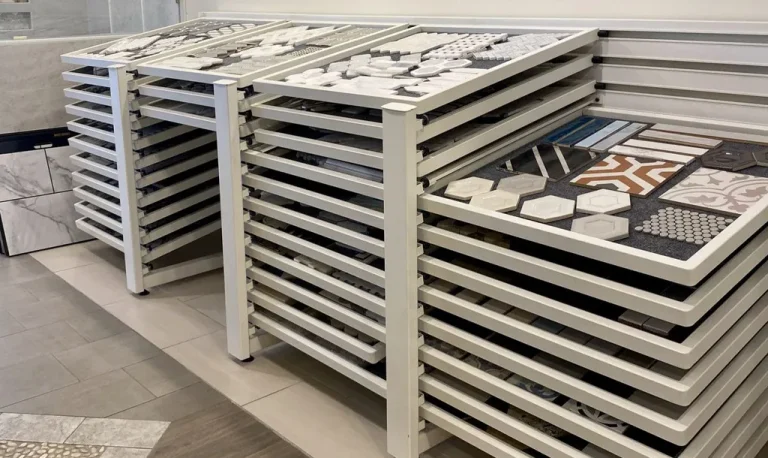
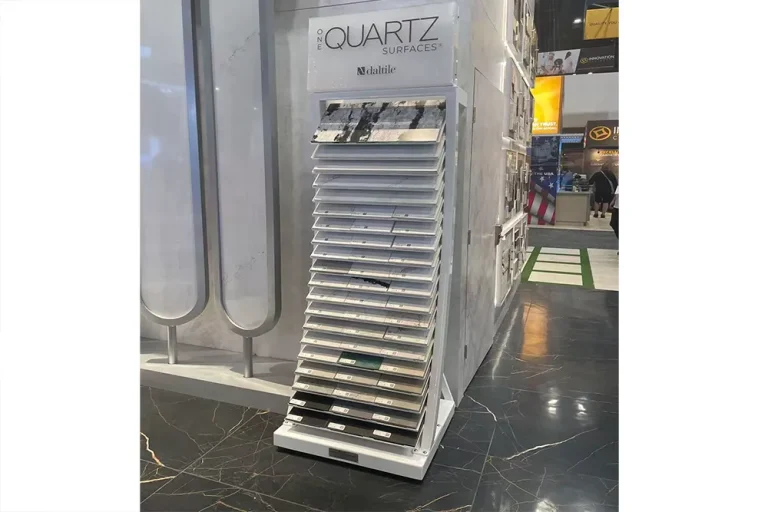
An inclined stone display stand presents samples at a controlled angle instead of keeping them completely vertical. This configuration is useful when customers need to compare color, veining, texture, and finish from a comfortable viewing position.
Inclined displays can also make better use of vertical space while keeping samples easy to access. The required angle, tier spacing, and shelf depth can be customized around the sample format.
See the inclined stone display stand for a current KYDISPLAY example designed for quartz, granite, marble, and artificial-stone samples.
3. Waterfall Stone Display Stand
A waterfall-style display presents one or several larger samples on inclined supports. It is useful when a showroom wants to give selected materials more visual space rather than fitting the maximum number of samples into one rack.
This configuration can be used for hero samples, featured collections, premium stone ranges, or areas where the surface pattern needs to be clearly visible.
The main customization points are sample dimensions, support spacing, display angle, frame dimensions, finish, and branding.
4. Rotating Stone Display Stand
A rotating or spinner display allows customers to access samples from multiple directions. It is particularly useful when the unit is placed in an open part of the showroom rather than directly against a wall.
Rotating systems can combine several display faces in one footprint, making them suitable for showrooms that need broad sample coverage while keeping the display area compact.
One KYDISPLAY example is the 4-sided spinner display stand, a 360-degree rotating configuration designed for tile and stone sample presentation.
5. Double-Sided Stone Display Stand
A double-sided stone display stand uses both faces of the structure, making it suitable for central showroom aisles, open display zones, and exhibition areas.
This configuration can increase the number of visible samples without requiring two separate floor fixtures. The overall height, width, depth, slot spacing, and sample capacity can be adjusted for the project.
For buyers comparing different display formats, our stone sample display stand types guide explains the differences between waterfall, spinner, A-frame, tower, and flat-insertion configurations.
6. Countertop Stone Sample Display Stand
A countertop display is designed for smaller samples and selection areas where a full-size floor rack is unnecessary.
It can be placed on a showroom counter, consultation desk, reception area, sample-selection table, or other compact space. Countertop formats are particularly useful when the sales team needs to keep frequently selected materials within easy reach.
KYDISPLAY also produces countertop stone sample displays with customized capacity, dimensions, finishes, logos, and optional features such as digital screens. See the countertop stone sample display stand for an example.
7. Wall-Mounted Stone Display
Wall-mounted displays use vertical wall space instead of relying entirely on floor space. They are useful for compact showrooms, sample libraries, consultation areas, and product zones where the floor must remain clear.
For this type of installation, the wall structure, fixing method, sample weight, clearance, and required capacity should be confirmed before production.
How to Choose the Right Stone Display Stand
The display type should be selected from the actual sample and showroom requirements. The following five factors provide a practical starting point.
1. Sample Size
Measure the actual width and height of the samples rather than choosing a rack based only on the material category.
Quartz, granite, and marble suppliers may use different sample formats, so the display openings and shelf dimensions should be designed around the samples you actually stock.
2. Sample Thickness and Weight
Thickness determines slot width and shelf clearance, while weight affects the structure and support requirements.
This is particularly important for granite, marble, quartz, and other dense materials that may be handled frequently in a commercial showroom.
Providing the actual sample thickness and approximate weight helps the manufacturer design a safer and more appropriate structure.
3. Required Capacity
Decide how many samples each unit needs to display.
A compact countertop unit may be suitable for a small selection, while a multi-layer floor display can be configured for a much larger collection. Capacity should always be considered together with sample dimensions and available space.
4. Available Floor or Wall Space
Measure the available width, depth, and height before choosing the display format.
Vertical and wall-mounted systems are useful where floor space is limited. Double-sided and rotating displays can be considered for open showroom areas where customers can approach the unit from more than one direction.
5. Customer Access
Consider how samples will be viewed, compared, and removed.
For frequently handled samples, open slots, sliding systems, inclined shelves, or individually accessible positions may be more practical than tightly packed displays.
What Can Be Customized?
For wholesale and OEM projects, customization usually starts with the physical requirements of the samples and then extends to appearance and branding.
| Customization | What It Controls |
|---|---|
| Overall size | Height, width, and depth of the stand |
| Sample dimensions | Slot, shelf, and support dimensions |
| Sample thickness | Slot width and clearance |
| Capacity | Number of samples, slots, shelves, or layers |
| Display angle | Viewing position and sample accessibility |
| Color | Black, white, grey, or custom RAL colors |
| Branding | Logo printing, engraving, nameplates, labels, and signage |
| Mobility | Fixed feet or caster wheels where required |
Which Stone Materials Can Be Displayed?
Custom display stands can be designed for both natural and engineered stone products. Typical applications include quartz, granite, marble, engineered stone, travertine, terrazzo, and related architectural surfaces.
The important point is that material type alone does not determine the rack design. Sample dimensions, thickness, weight, quantity, and handling requirements are usually more important when specifying the structure.
For general information about natural stone types such as granite and marble, the Natural Stone Institute’s stone fact sheet provides industry background on common natural stone materials.
What Should You Send a Manufacturer for a Custom Quote?
When requesting a quotation for customizable stone display stands, provide as much of the following information as possible:
- Sample photos
- Sample width and height
- Sample thickness
- Approximate sample weight when available
- Required samples per display
- Preferred display format
- Available showroom dimensions
- Preferred color or RAL code
- Logo and branding requirements
- Required quantity and shipping destination
If the preferred stand type is not known, sample photos plus the available showroom space are usually a better starting point than simply asking for a standard rack.
Customizable Stone Display Stands for Wholesale Projects
For importers, distributors, stone brands, showroom groups, and other B2B buyers, a display stand is normally part of a broader material-presentation system.
KYDISPLAY provides OEM and ODM display manufacturing for stone, tile, and related building-material samples. Depending on the project, the design can be adapted for sample dimensions, capacity, layout, color, branding, and other functional requirements.
For a broader product range, you can also review the stone display rack collection and compare different floor-standing and countertop configurations.
Frequently Asked Questions
What are customizable stone display stands?
Customizable stone display stands are display fixtures designed around specific sample dimensions, thickness, capacity, showroom space, finish, and branding requirements.
What stone materials can these stands display?
They can be designed for quartz, granite, marble, engineered stone, natural stone, travertine, terrazzo, and other architectural surface samples.
Can a stone display stand be made for a specific sample size?
Yes. The overall dimensions, slot spacing, shelf depth, and display positions can be customized according to the actual sample size.
Can the stand be customized for different sample thicknesses?
Yes. Slot width and shelf clearance can be adjusted when the manufacturer receives the actual sample thickness.
Are these stands suitable for quartz and granite samples?
Yes. Vertical, inclined, rotating, double-sided, countertop, and other display configurations can be designed for quartz and granite samples according to their size, thickness, and weight.
Can I add my company logo?
Yes. Depending on the design, branding can include printed logos, laser engraving, metal nameplates, labels, or signage.
Can the color be customized?
Yes. Common options include black, white, and grey, while custom RAL colors can be specified for many projects.
Which display type is best for a small showroom?
Vertical, wall-mounted, and countertop systems are often considered when floor space is limited. The best configuration depends on sample size and the number of samples that need to be displayed.
Can one display stand hold different stone materials?
Yes, provided the sample dimensions and thicknesses are compatible with the same display structure. Different sample formats may require different slot or shelf configurations.
What information is needed for a custom quotation?
A manufacturer normally needs sample dimensions, thickness, required capacity, preferred display type, available space, color, branding requirements, quantity, and shipping destination.
Request a Custom Stone Display Stand Quote
If you are sourcing display stands for a stone showroom, distributor network, or material brand, send your sample dimensions, thickness, required capacity, quantity, and destination.
KYDISPLAY can evaluate the requirements and propose a display structure based on your samples, showroom layout, and branding needs.
Request a Quote for Customizable Stone Display Stands