A STONE DISPLAY SOLUTION EXPERT !



Sliding vs Rotating Stone Display Racks: 5 Best Tips
Table of Contents
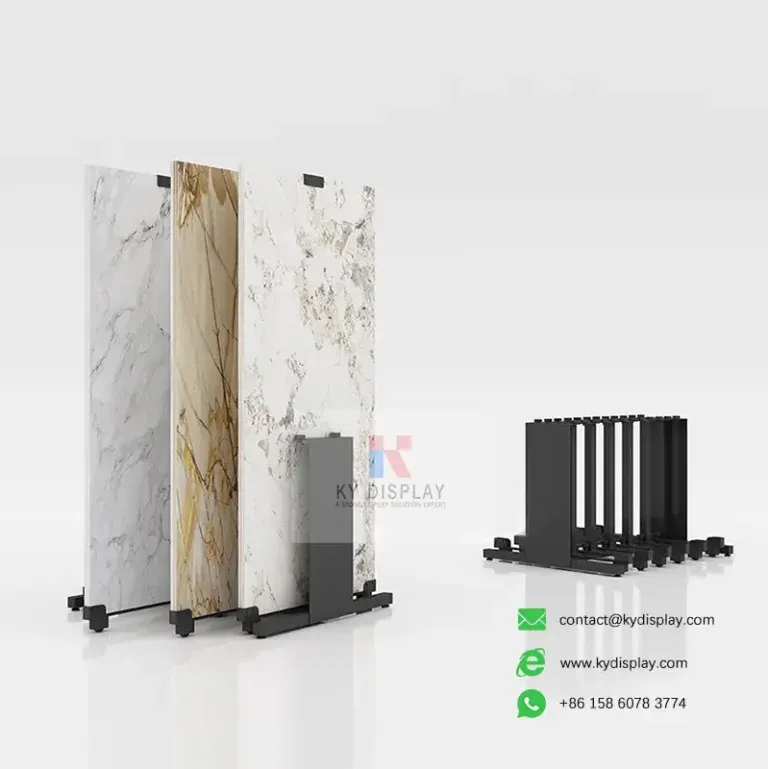
A stone display rack is a fixture that presents marble, quartz, and granite samples at scale so customers can compare veining, finish, and size without lifting full slabs. When a showroom compares sliding vs rotating stone display racks, the real decision is about footprint, capacity, and how staff browse stone during a busy hour. Both solve the same job — showing heavy samples safely — but they fit different floor plans, traffic patterns, and buyer priorities.
Who this is for: importers, tile and stone showroom owners, and building-material retailers. North America and Europe are the largest consumption markets, while China supplies more than 60% of global racks — so most buyers are specifying fixtures from overseas OEM/ODM partners.
Sliding vs Rotating Stone Display Racks: What Each Does
A sliding stone display rack holds samples in vertical trays or panels that pull straight out on rails. Customers slide one panel forward to view a slab face, then push it back and pull the next. The mechanism keeps every sample in a fixed, narrow footprint, which is why sliding racks dominate compact stone showrooms and tight aisles.
Typical sliding models on the market carry 20–40 slabs in a floor footprint of roughly 600–900 mm wide (industry reference; confirm against the exact KY model). Our Double Sided 4 Panel Slab Display Rack – 16-Slab Freestanding Showroom Stand is a representative example: it shows 16 slabs back-to-back while occupying a small floor area, and the double-sided layout lets two customers browse at once.
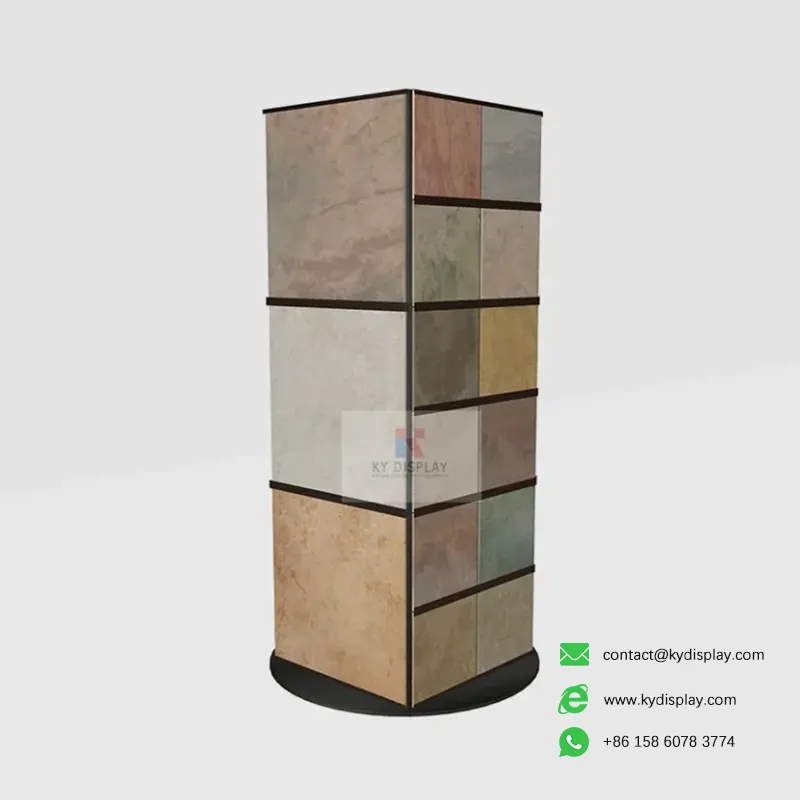
A rotating stone display rack spins samples around a central axis, usually 360°, on a base of roughly 400–600 mm. Shoppers stand in one spot and turn the tower to see the full range. Rotation turns browsing into interaction — which is why rotating racks work well in corner zones and entrance features where floor space is tight but visibility matters. The trade-off is capacity per square metre: a rotating tower shows breadth (many collections) but not depth (full-size formats), so most showrooms pair it with fixed walls for hero slabs.
Sliding vs Rotating Stone Display Racks: Head to Head
| Factor | Sliding Stone Rack | Rotating Stone Rack |
|---|---|---|
| Floor footprint (empty) | 600–900 mm wide, deep | 400–600 mm base, compact |
| Footprint (loaded) | Slabs stay within rack — predictable | Tower + person turning = needs clearance ring |
| Capacity | 20–40 slabs typical | 12–30 samples typical |
| Best slab size | Full slabs and large formats | Sample boards and mid formats |
| Browse style | Pull-and-compare, two-handed | Spin-and-scan, one-handed |
| Staff effort | Moderate (slide panels) | Low (turn tower) |
| Cost range | Mid to high (rail hardware) | Mid (bearing + frame) |
| Best for | Compact showrooms, slab yards | Corners, entrances, trade booths |
Buyer trap: when you weigh sliding vs rotating stone display racks, the rack with the smallest empty footprint is not automatically the most space-efficient. Add slab projection + viewing distance + aisle + loading clearance — two racks with identical outside dimensions can create very different showroom layouts.
Which to Choose by Showroom Type
The sliding vs rotating stone display racks decision should start from your showroom layout, not from generic “heavy duty” claims.
- Small boutique showroom: choose sliding. Highest slab count per square metre, aisles stay clear.
- Large slab yard: choose sliding for the deep range, add one rotating tower at the entrance as a feature.
- Trade show or pop-up: choose rotating. One base shows the whole collection and breaks down fast for shipping.
Three Mistakes to Avoid (from Real Buyer Audits)
- Ignoring loaded dimensions — size the zone for the slab, not the empty frame.
- Mixing stone weights on one soft rack — size every tier to the heaviest slab; quartz is denser than marble.
- Skipping the logo header — a branded top panel makes the fixture memorable when clients photograph the showroom.
For buyers aligning fixtures with industry practice, the Natural Stone Institute publishes slab handling and safety resources, while Marmomac remains the global reference event for the natural stone supply chain.
Ready to shortlist sliding vs rotating stone display racks for your showroom? KYDISPLAY builds both as OEM/ODM with your logo, dimensions, and finishes — start a free quote via the custom display rack page.
Frequently Asked Questions
Are sliding or rotating stone racks better for small showrooms?
Sliding racks win on capacity per square metre, so they suit small showrooms. Rotating racks suit corners and entrances where you want interaction in minimal floor space.
How many slabs fit in a sliding stone display rack?
Typical sliding models hold 20–40 slabs, depending on tray pitch and board thickness (industry reference; confirm per KY model). Wider pitch fits fewer but protects heavier stones.
How much floor space does a rotating stone rack need?
A rotating tower usually needs a 400–600 mm base, plus clearance for a person to stand and turn it. It is among the most space-efficient formats by empty footprint.
Can one rack hold both marble and quartz?
Yes, but size every tier to the heavier stone. Quartz is denser than marble, so use reinforced steel and padded dividers so softer marble still rests safely.
Do sliding stone racks need power?
No. Quality sliding and rotating racks are mechanical (rails or bearings) and need no electricity, though some showrooms add optional LED strips.
Where can I get a custom sliding or rotating stone rack?
KYDISPLAY builds both as OEM/ODM with your logo, dimensions, and finishes via its custom display rack quote page.