A STONE DISPLAY SOLUTION EXPERT !



Tile Showroom Lighting: How to Plan Light That Makes Tiles Look True and Sell Faster
Table of Contents
Tile is the rare product customers judge almost entirely with their eyes. The same porcelain that looks warm beige under your track spots can read stark gray in a customer’s kitchen, and when that happens the showroom takes the blame. Getting tile showroom lighting right is therefore not decoration — it is color accuracy, texture and sales conversion built into one system. This guide breaks the job into 7 practical rules, with the exact numbers lighting designers specify: CRI, color temperature, beam angles, lux levels and maintenance intervals.
| Specification | Recommended Target | Why It Matters |
|---|---|---|
| CRI | 90 minimum, 95+ ideal | Tile colors read true under the lights |
| R9 (red rendering) | Above 50, above 80 better | Keeps terracotta, rust and burgundy tones honest |
| Color temperature | 3000K–4000K (3500K neutral) | Balances warmth with accurate undertones |
| Track beam angle | 36 degrees | Even coverage without hotspots on panels |
| Sample wall illuminance | 600–800 lux | Enough detail for close color comparison |
| LED lifetime | 50,000+ hours | Fewer lamp changes across a large showroom |
Tile Showroom Lighting: Why It Decides Whether Tiles Sell
Stone-industry guides such as SlabWise describe the core problem precisely: the same slab can look like two different products under two different lights. A tile that reads clearly gray-beige in daylight can turn muddy under a low-CRI lamp, and colors that look clearly different in natural light can read as identical under the CRI 80 fixtures found in most offices. Buyers make their decision in your showroom but live with the tile at home — and surprise after installation almost always turns into regret, returns and bad reviews.
Good tile showroom lighting solves this before it happens. Within the broader tile showroom design, it does three jobs at once: it renders color truthfully, it reveals surface texture, and it guides visitors toward your best-margin displays. The 7 rules below cover all three.
Rule 1 — Layer Ambient, Accent and Task Light
Professional showrooms never rely on one grid of ceiling lights. They layer three types of light, each with its own job — and the layering stays the same whether your samples sit on perimeter walls or on freestanding islands, as we compare in freestanding display towers vs tile display walls.
Ambient: the even base layer
Linear LED strips and recessed downlights wash the whole floor evenly, keeping aisles and consultation areas around 300–500 lux — bright enough to walk and talk, never glaring. Uniform ambient light also stops dark corners from swallowing half your displays.
Accent: the spotlight layer
Adjustable track spotlights are aimed at featured walls and hero samples, pushing those surfaces up to roughly 600–800 lux. The brightness contrast between aisle and display is what pulls the eye — and the customer — toward the samples you most want to sell.
Task: the working layer
Consultation desks and touch-and-feel counters need focused light for comparing samples side by side and reading drawings. Under-shelf strips and pendant lights over the desk keep this zone functional without spilling glare across the showroom.
Rule 2 — Demand CRI 90 or Higher
Why standard office LEDs fail
CRI (Color Rendering Index) scores how faithfully a light source shows color, from 0 to 100. Most commercial office lighting sits at CRI 80, which is genuinely inadequate for material selection: under it, samples lose subtle undertones and two visibly different tiles can collapse into the same color. Treat CRI 90 as the floor for any serious tile showroom lighting plan, and CRI 95 and above — museum grade — where the budget allows.
Do not skip the R9 score
Headline CRI is averaged over eight pastel test colors, and none of them is saturated red. R9 measures red rendering separately, and it decides whether terracotta floors, rust veining and burgundy stone-look tiles keep their warmth. Aim for R9 above 50; above 80 is better. Most LED spec sheets list it — ask for it.
Rule 3 — Keep Color Temperature Between 3000K and 4000K
Match the temperature to the range
Color temperature decides whether a tile reads warm or cold. Around 3000K flatters wood-look and earth-tone collections; 3500K neutral white is the sweet spot for accurate ceramic and paint matching; 3500K–4000K suits stone-look ranges where veining must read clean. Showrooms carrying mixed collections often mix temperatures zone by zone instead of forcing one value across the whole floor.
Never light samples with 5000K or above
Cool-white and blueish light above 5000K washes out warm tones and lies about color — it makes cream tiles look clinical and gray tiles look dead. If your current fixtures drift cold, re-lamping the sample walls first delivers the biggest visible improvement per dollar.
Rule 4 — Hang 36 Degree Track Lights Over Display Racks
Why beam angle matters
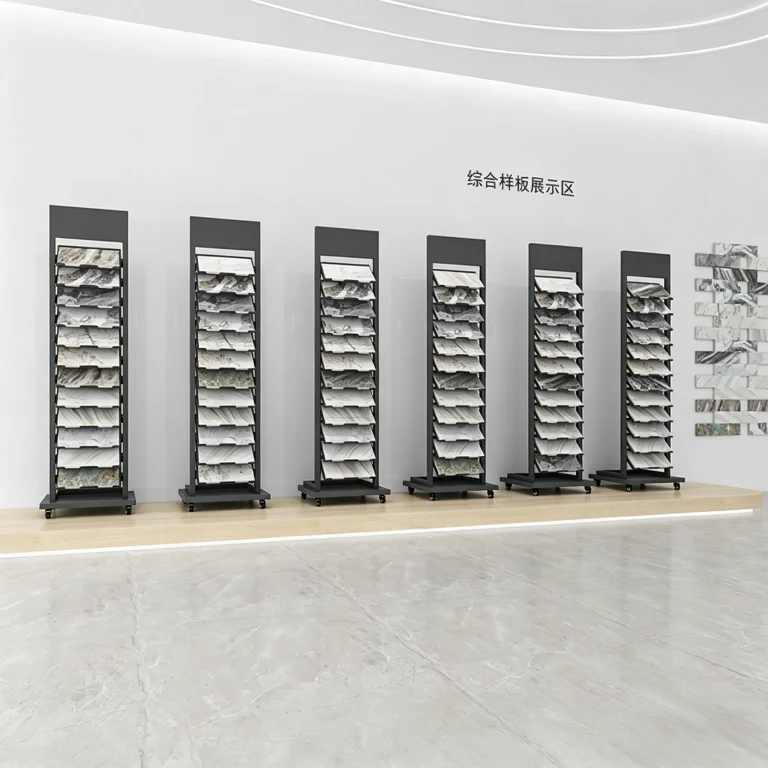
Beam angle decides whether light lands softly or burns a hole. Narrow 15–24 degree spots concentrate too much energy on one point of a fixed panel, overexposing the surface and leaving the rest of the wall dull. Around 36 degrees is the practical choice for tile display racks: wide enough for even coverage, tight enough to keep the light on the sample.
Use uniform lens spots and the right distance
Lens-type track lights with even light distribution keep the spot soft and consistent, so wherever a sample sits on the rack the surface reads uniformly. Aim them at roughly a 45 degree angle across textured and matte finishes — the raking angle exaggerates surface relief, which is exactly what sells structure and wood-effect surfaces. Mount the track far enough back that light reaches the middle and back rows of a deep display case, not just the front panel.
Rule 5 — Light the Racks Themselves
Build lighting into the fixture
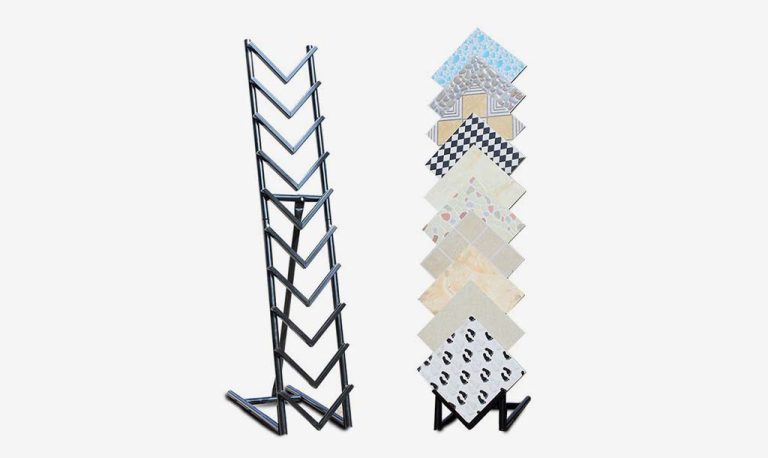
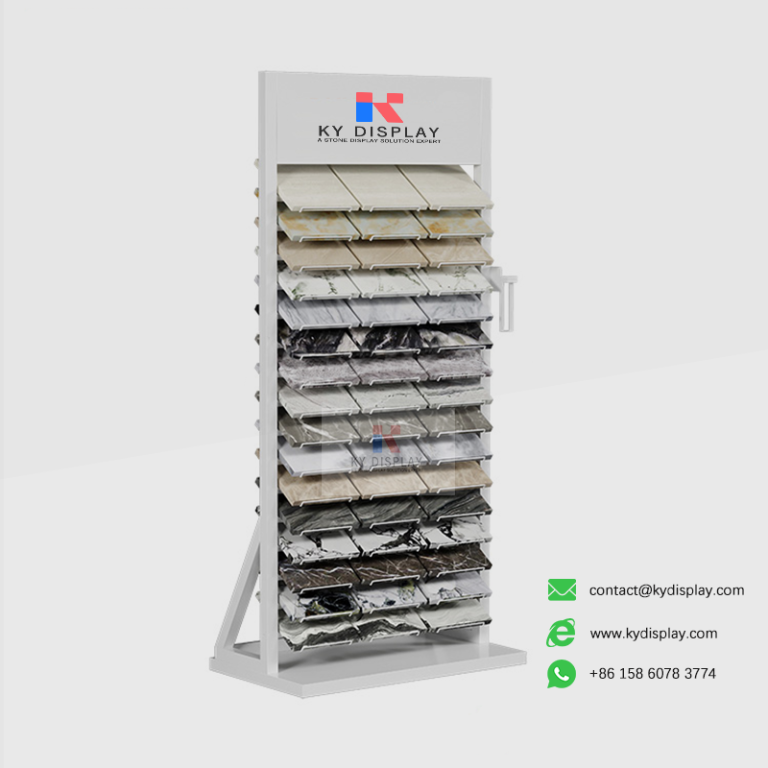
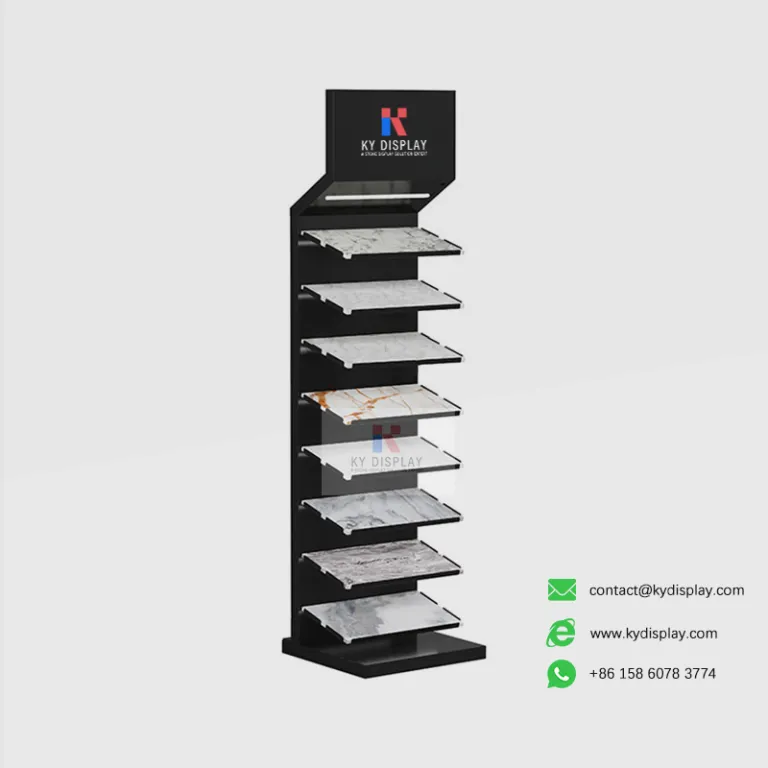
Ceiling tracks alone cannot follow a pull-out drawer or a sliding panel. Modern push-pull tile display stands and modular wall tile displays can be ordered with integrated LED strips or backlighting, so the light moves with the sample instead of falling behind the innermost layer. This is the cleanest fix for display cabinets where movable panels break ceiling-only schemes.
Backlight the premium zone
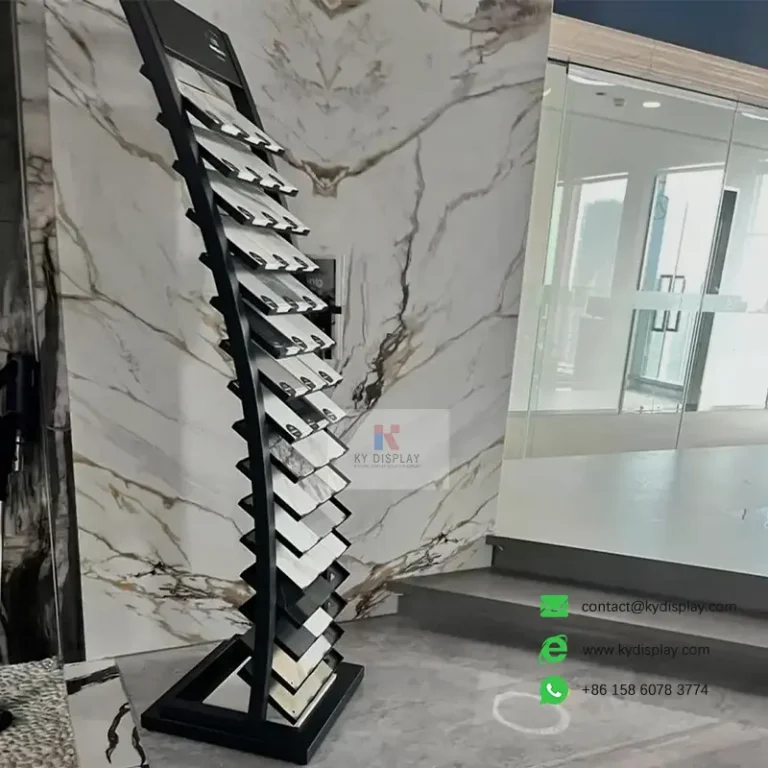
Warm backlighting behind translucent onyx-look and glass slabs turns a sample wall into a feature moment — it shows veining depth and translucency that flat lighting hides, and it reliably anchors the premium corner of a showroom. Pair it with a tilted tile sample display rack under grazing light and even mid-range collections gain a high-end read.
Rule 6 — Tame Daylight, Glare and UV
Storefront glass gives you free light, but unmanaged daylight and glare cost sales. Control them with three moves:
- Cut glare on polished tiles. Polished and glossy surfaces mirror fixtures; angle spots away from the customer sight line and favor lens-type fixtures with low glare so shoppers can look up at the wall without squinting.
- Block UV at the glass. Material samples displayed near south-facing windows can fade within 12 months. Apply UV-blocking window film and rotate window-adjacent samples regularly so no line fades on display.
- Balance daylight with layers. Keep accent light bright enough to hold up at midday, so your hero wall never goes flat when the sun is strong.
Rule 7 — Audit and Maintain Every Season
Lighting is a system, not a fit-and-forget purchase. Quality high-CRI LEDs run 50,000 hours or more and cost more upfront than standard fixtures, but the five-year operating cost difference is small — and far cheaper than the sales lost to faded, badly lit samples. Once a season: clean the lenses, re-aim spots after every rack rearrangement, replace flickering lamps immediately, and re-check color temperature consistency whenever you add fixtures. A consistent light field is what makes a whole wall read as one collection.
Tile Showroom Lighting Mistakes That Cost Sales
- One flat layer of warehouse LEDs. A single 4000K grid renders every finish flat and lets hotspots go unnoticed.
- Chasing brightness over color quality. Lighting guidance for building-material retail is explicit: spectral quality matters more than raw lumen output.
- Wrong beam angles. Narrow spots overexpose the panel they hit and starve the rest of the wall.
- Ignoring the R9 score. High CRI with low R9 still mutes every warm, red-toned range you stock.
- Set-and-forget. After every collection swap, un-aimed spots waste half the investment you made in light.
Get a Free Quote
Planning tile showroom lighting as part of the overall tile showroom design — not as an afterthought — saves rewiring later. KY Display has spent 16 years building custom tile, stone and flooring display systems for distributors worldwide — including racks with integrated LED backlighting — and pairs them with a free showroom plan built to your floor dimensions. Send us your showroom size and we will reply within 24 hours.
Frequently Asked Questions
1. What CRI do I need for tile showroom lighting?
Treat CRI 90 as the minimum for any surface customers choose from, and CRI 95 or higher where budget allows — the same grade museums use. Also check the R9 score: above 50 is the practical floor for keeping red and terracotta tones honest.
2. What color temperature is best for displaying tile?
Stay between 3000K and 4000K. Around 3000K flatters wood-look and earth tones, 3500K is the neutral sweet spot for ceramic, and up to 4000K suits stone-look veining. Avoid anything at 5000K or above — cool light washes out warm colors.
3. What beam angle should track lights have over display racks?
Around 36 degrees. Narrower 15–24 degree spots concentrate light into hotspots on fixed panels, while lens-type fixtures with uniform distribution keep the whole sample surface evenly soft.
4. How bright should a tile showroom be?
Lighting designers commonly target roughly 600–800 lux on sample walls and 300–500 lux in aisles and consultation areas. Prioritize spectral quality — CRI and R9 — over raw brightness.
5. Can tile display racks include lighting?
Yes. Many pull-out and sliding systems accept integrated LED strips or backlighting, so illumination moves with the sample instead of being blocked by inner panels. Order lighting as part of the rack specification rather than retrofitting later.
More Tile Showroom Guides
Lighting works together with the floor plan — start with our tile showroom layout guide, then add the tactics in 10 proven tile showroom display ideas. For fixture selection, see our guide to choosing the right commercial tile display rack.